800-Year-Old Tomb Discovered in Peru

LIMA, PERU—The remains of eight people estimated to be 800 years old were discovered by workers laying gas pipes near Lima, according to an ...

Thursday

New Thoughts on Maya Pyramid in El Salvador

BOULDER, COLORADO—According to a Live Science report, the Campana structure, a Maya pyramid in El Salvador’s Zapotitán Valley, was built with cut stone, earth, and tephra ejected by the Tierra Blanca Joven eruption of the Ilopango caldera, which is located about 25 miles away. Recent radiocarbon dating of tree trunks in El Salvador indicates that the eruption occurred around A.D. 539. It had been previously thought that the Maya abandoned their settlements in the ash-covered region for centuries after the eruption, but archaeologist Akira Ichikawa of the University of Colorado Boulder said that the dating of carbon samples from the pyramid’s building materials suggests construction occurred between A.D. 545 and 570. Ichikawa thinks the inclusion of tephra in the pyramid could reflect the spiritual significance of volcanoes in Maya culture. To read about the only Maya city with an urban grid, go to "The City at the Beginning of the World."

This Civil War–Era Eagle Sculpture Was Made Out of Abraham Lincoln's Hair

The unusual artifact also contains tresses from First Lady Mary Lincoln, members of the president's cabinet and senators

from History | smithsonianmag.com https://ift.tt/3kzA1A7

Roman gold coins found off coast of Spain

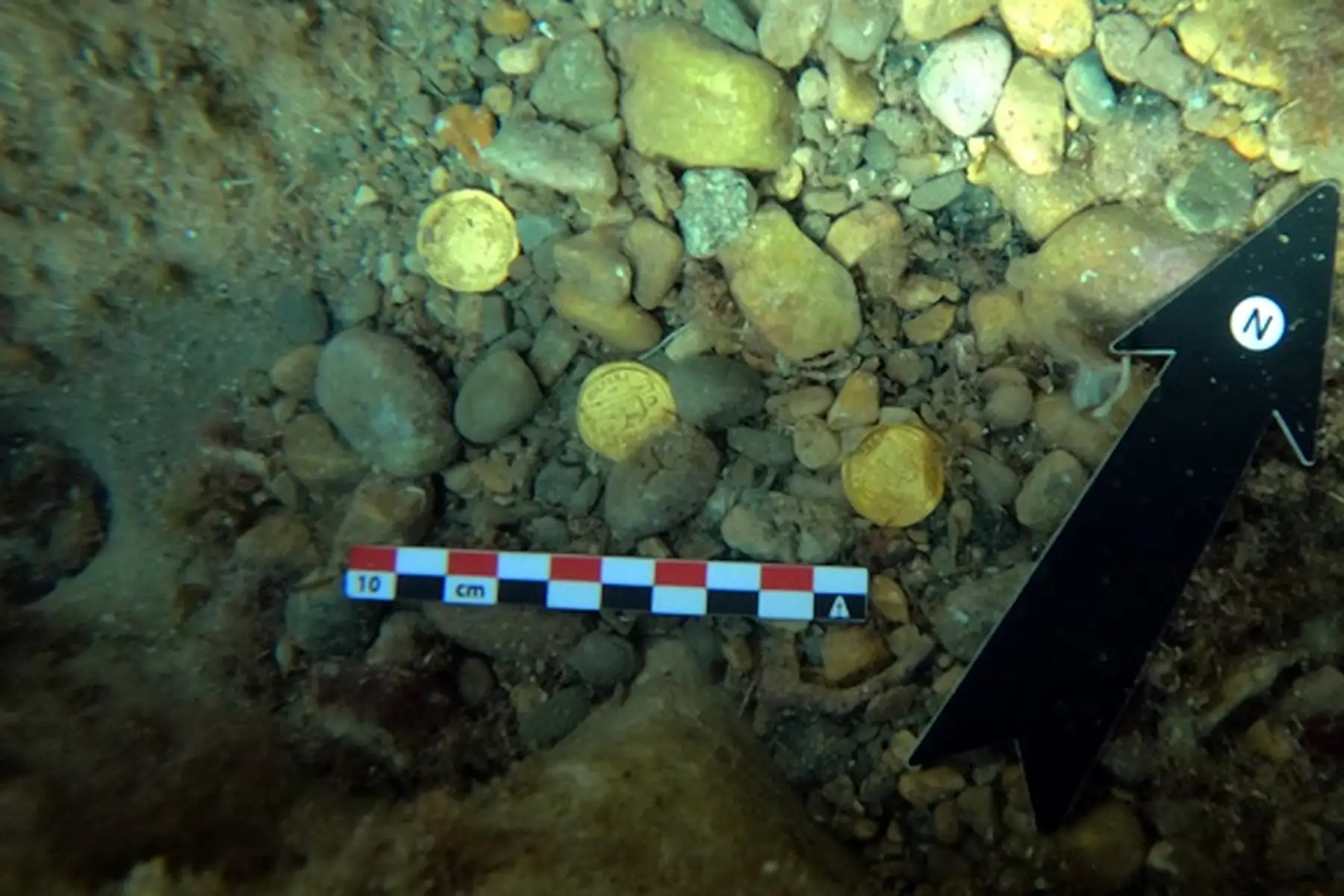
A group of 53 Roman gold coins have been discovered on the seabed off the coast of Xàbia in Alicante, southeastern Spain. They are gold solidi ranging in date from the late 4th to the early 5th century, and are in such excellent condition that all the coins but one could be identified. There are three solidi from the reign of Emperor Valentinian I, seven from  Valentinian II, 15 from Theodosius I, 17 from Arcadius and 10 from Honorius.

The coins were discovered on the sea bottom next to Portitxol island, a popular destination for sport divers because of the rich marine life that inhabits its seaweed meadows of its rocky bed. Even so, it managed to hide dozens of Roman gold coins for 1,500 years until freedivers Luis Lens and César Gimeno spotted eight flashes of light on the seafloor. At first they thought they were modern ten cent pieces, or maybe mother-of-pearl shells gleaming in the water. They picked up two of them.

When they returned to the boat, they saw that they were ancient gold coins bearing identical profiles of a Roman emperor. They immediately alerted city officials to their discovery and led marine archaeologists to the find site. Over several dives, the team of archaeologists recovered the 53 gold coins, three copper nails and fragments of lead that may have been fittings on a chest.

This is one of the largest sets of Roman gold coins found in Spain and Europe, as stated by  Professor in Ancient History Jaime Molina and University of Alicante team leader of the underwater archaeologists working on the wreck. He also reported that this is an exceptional archaeological and historical find, since it can offer a multitude of new information to understand the final phase of the fall of the Western Roman Empire. The historians point to the possibility that the coins may have been intentionally hidden, in a context of looting such as those perpetrated by the Alans in the area at that time.

Therefore, the find would serve to illustrate a historical moment of extreme insecurity with the violent arrival of the barbarian peoples (Suevi, Vandals and Alans) in Hispania and the final end of the Roman Empire in the Iberian Peninsula from 409 A.D.

The coins are now being conserved and studied before going on display at the Soler Blasco Archaeological and Ethnographic Museum in Xàbia, conditioned on the acquisition of an armored glass case equipped with sensors to secure the valuable (and easily meltable) artifacts. Funding has already been secured to return to the find site for a more thorough excavation.

Share


from The History Blog https://ift.tt/3o17aXs

Roman gold coins found off coast of Spain

A group of 53 Roman gold coins have been discovered on the seabed off the coast of Xàbia in Alicante, southeastern Spain. They are gold solidi ranging in date from the late 4th to the early 5th century, and are in such excellent condition that all the coins but one could be identified. There are three solidi from the reign of Emperor Valentinian I, seven from  Valentinian II, 15 from Theodosius I, 17 from Arcadius and 10 from Honorius.

The coins were discovered on the sea bottom next to Portitxol island, a popular destination for sport divers because of the rich marine life that inhabits its seaweed meadows of its rocky bed. Even so, it managed to hide dozens of Roman gold coins for 1,500 years until freedivers Luis Lens and César Gimeno spotted eight flashes of light on the seafloor. At first they thought they were modern ten cent pieces, or maybe mother-of-pearl shells gleaming in the water. They picked up two of them.

When they returned to the boat, they saw that they were ancient gold coins bearing identical profiles of a Roman emperor. They immediately alerted city officials to their discovery and led marine archaeologists to the find site. Over several dives, the team of archaeologists recovered the 53 gold coins, three copper nails and fragments of lead that may have been fittings on a chest.

This is one of the largest sets of Roman gold coins found in Spain and Europe, as stated by  Professor in Ancient History Jaime Molina and University of Alicante team leader of the underwater archaeologists working on the wreck. He also reported that this is an exceptional archaeological and historical find, since it can offer a multitude of new information to understand the final phase of the fall of the Western Roman Empire. The historians point to the possibility that the coins may have been intentionally hidden, in a context of looting such as those perpetrated by the Alans in the area at that time.

Therefore, the find would serve to illustrate a historical moment of extreme insecurity with the violent arrival of the barbarian peoples (Suevi, Vandals and Alans) in Hispania and the final end of the Roman Empire in the Iberian Peninsula from 409 A.D.

The coins are now being conserved and studied before going on display at the Soler Blasco Archaeological and Ethnographic Museum in Xàbia, conditioned on the acquisition of an armored glass case equipped with sensors to secure the valuable (and easily meltable) artifacts. Funding has already been secured to return to the find site for a more thorough excavation.

Share


source http://www.thehistoryblog.com/archives/62305

Review of The Bombay Prince by Sujata Massey, a mystery of 1920s India

The “Bombay prince” is the future Edward VIII, who in November 1921 took a four-month tour of India, one of the many colonial lands he expected to rule one day. Many Indians supporting independence were angry about the visit, which led to calls for boycotts and agitation in the streets.

This historic event is the setting for the third in Sujata Massey’s excellent mysteries of 1920s India featuring Perveen Mistry, the country’s first female solicitor (she’s fictional but based on a real-life figure).

Miss Freny Cuttingmaster, a talented student at Woodburn College, stops by Mistry Law for a legal consultation with Perveen. She and her classmates are required to attend the parade celebrating the Prince of Wales’s arrival in Bombay, but Freny detests what he symbolizes and wants to stay away. Impressed by her principles, Perveen advises her as best she can. Then, on the day of the procession, poor Freny’s body is found on the ground, beneath a balcony on her campus. Was her death suicide-as-protest, a political murder, or something else?

Massey admirably directs a cast of dozens, all with distinct personalities and with a range of religious backgrounds. The amount of cultural information smoothly woven through these pages is astounding and is exhibited via the characters’ interactions. The Cuttingmasters are Parsis, like Perveen, which leads her and her lawyer father, Jamshedji, to advocate for Freny’s distraught parents during the coroner’s inquest and ensure her funeral at Doongerwadi isn’t improperly delayed. Feeling an affinity for their late daughter, Perveen wants to see justice done, but she’s disconcerted by Mr. Cuttingmaster’s abruptness (he’s a tailor, as his name suggests) and tries to act without causing offense. She doesn’t always succeed.

Perveen’s manner feels stiff at times, which she acknowledges; it feels appropriate to her status as a pioneering woman in her field who happens to be separated from an abusive husband. Both on the job and within society, her behavior must be above reproach, plus Jamshedji disapproves of her socializing with men. This includes Colin Sandringham, an English political agent helping to arrange the prince’s itinerary. Readers of the previous book will be happy to see him again. Perveen and Colin had become close during her trip to Satapur, but as for a relationship between them – there be danger ahead, she knows.

Followers of the series should delight in how this book ends, and anyone tempted by mentions of the delicious Indian dishes consumed by the characters can find recipes on the author’s website.

The Bombay Prince was published by Soho in 2021; thanks to the publisher for approving me on NetGalley.


from Reading the Past https://ift.tt/39ty69E

Wednesday

DNA Analysis Identifies Japanese Ancestors

DUBLIN, IRELAND—According to a Live Science report, analysis of DNA samples obtained from ancient bones unearthed at various sites across Japan has detected a previously unidentified genetic group that migrated to Japan during the Kofun period, between A.D. 300 and 700, when Japan transitioned into an imperial state. This group is thought to be one of three populations ancestral to modern Japanese people. The other two groups have been identified as Jomon-period hunter gatherers who arrived in Japan as early as 20,000 years ago, and Yayoi-period farmers who migrated to Japan from East Asia between 900 B.C. and A.D. 300. Were the political changes that took place during the Kofun period brought about by this newly detected influx of new people? “Cultural transitions could have happened without involving genetic changes,” said Shigeki Nakagome of Trinity College Dublin. But the Kofun-period migrants came from East Asia and may have been Han people from China, he added. “To see if this East Asian ancestry played a key role in the transition, we need to sequence people with a higher rank,” he said. For more, go to "Japan's Early Anglers." 

Ritual Objects Discovered in Northern Egypt

CAIRO, EGYPT—Ahram Online reports that researchers from Egypt’s Supreme Council of Antiquities have uncovered artifacts used in rituals honoring the goddess Hathor in the Temple of the Pharaohs at the site of the ancient city of Buto, which is located in the Nile Delta. The instruments, which date to the 26th Dynasty (688-525 B.C.), include a limestone pillar shaped like the goddess; faience incense burners, one of which is decorated with the head of the god Horus; pottery; statuettes of the deities Tawart and Djehuty; a maternity chair; an offering holder; a gold Udjat eye; and golden scales thought to have been used in the gilding of other objects. The researchers also found ivory carved with scenes of women carrying offerings and pictures of plants, birds, and animals; a limestone lintel carved with hieroglyphic texts; and part of a painting of a king performing a ritual in the temple. To read about the sacred site of Heliopolis on the Nile, go to "Egypt's Eternal City."

'Band of Brothers' Stars Reflect on the Epic Miniseries' Evolving Legacy

HBO's beloved World War II drama premiered 20 years ago this month

from History | smithsonianmag.com https://ift.tt/3ufuj9T

‘Cake mummy’ survived WWII bombing of Lübeck

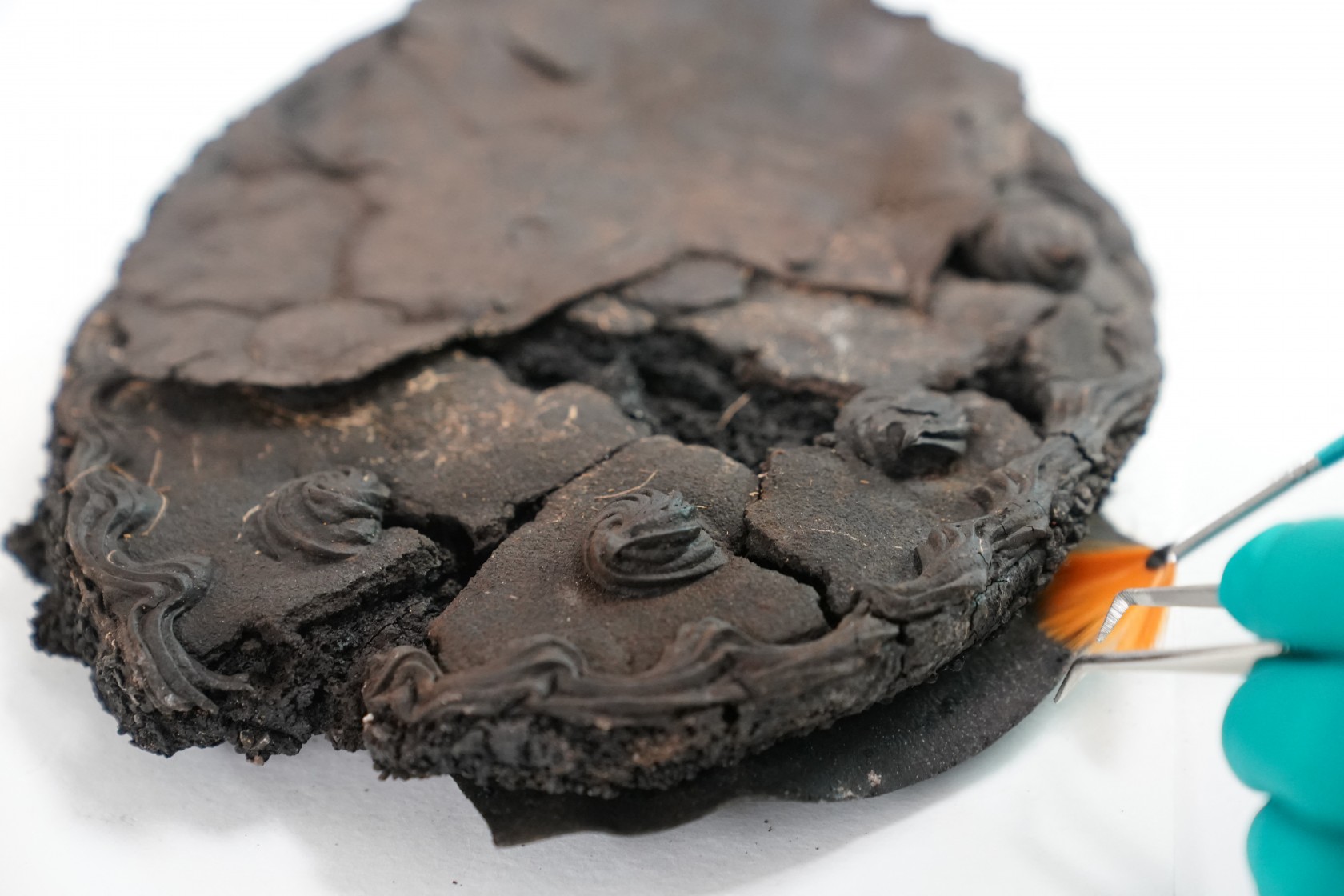
A hazelnut cake complete with swirls of frosting carbonized in the bombing of Lübeck in 1942 has been discovered in a cellar in the city’s historic old town. No food preserved in the firestorm of the bombing has been discovered before in Lübeck. Nor are there any comparable survivors from Hamburg or Dresden, two other German cities that were famously devastated by Allied firebombing.

City archaeologists unearthed the cake in April during an excavation under a house on the Alfstrasse, a street that leads from the Trave river to Lübeck’s iconic 13th century St. Mary’s Church. Built in 1159, barely 15 years after the city’s founding, Alfstrasse is one of the oldest streets in the Lübeck located in the very heart of the city’s founding district.

Lübeck was bombed by the Royal Air Force the night of March 28-29th, 1942, and the fires that resulted destroyed large parts of its medieval city center. St. Mary’s was all but levelled (it was reconstructed after the war), as was the merchants’ quarter. The house on Alfstrasse was destroyed in the bombing, but by a miraculous cake-preserving fluke, a cavity formed under the rubble that insulated the dessert from annihilation in the fires or from being crushed in the house’s collapse.

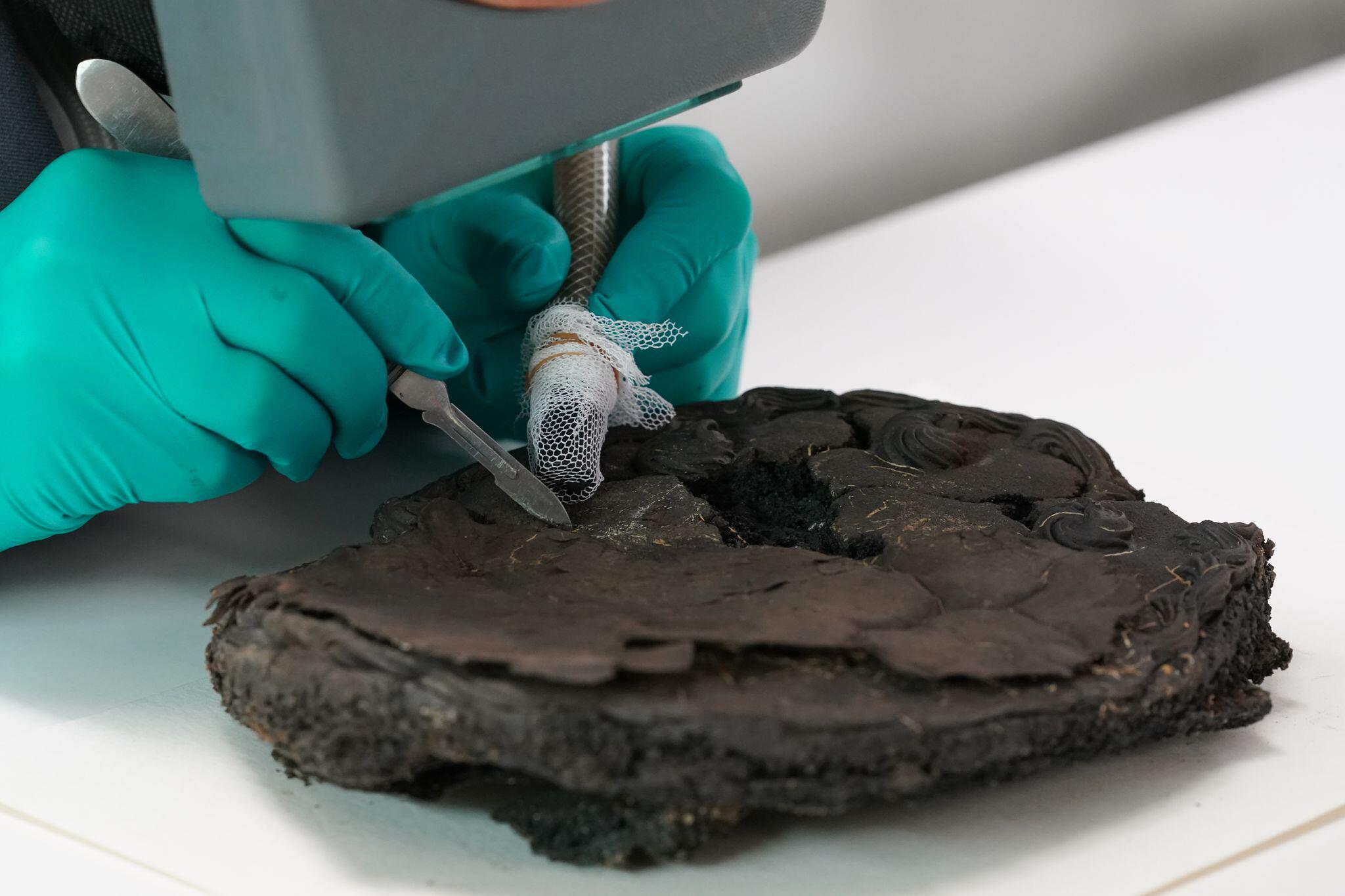
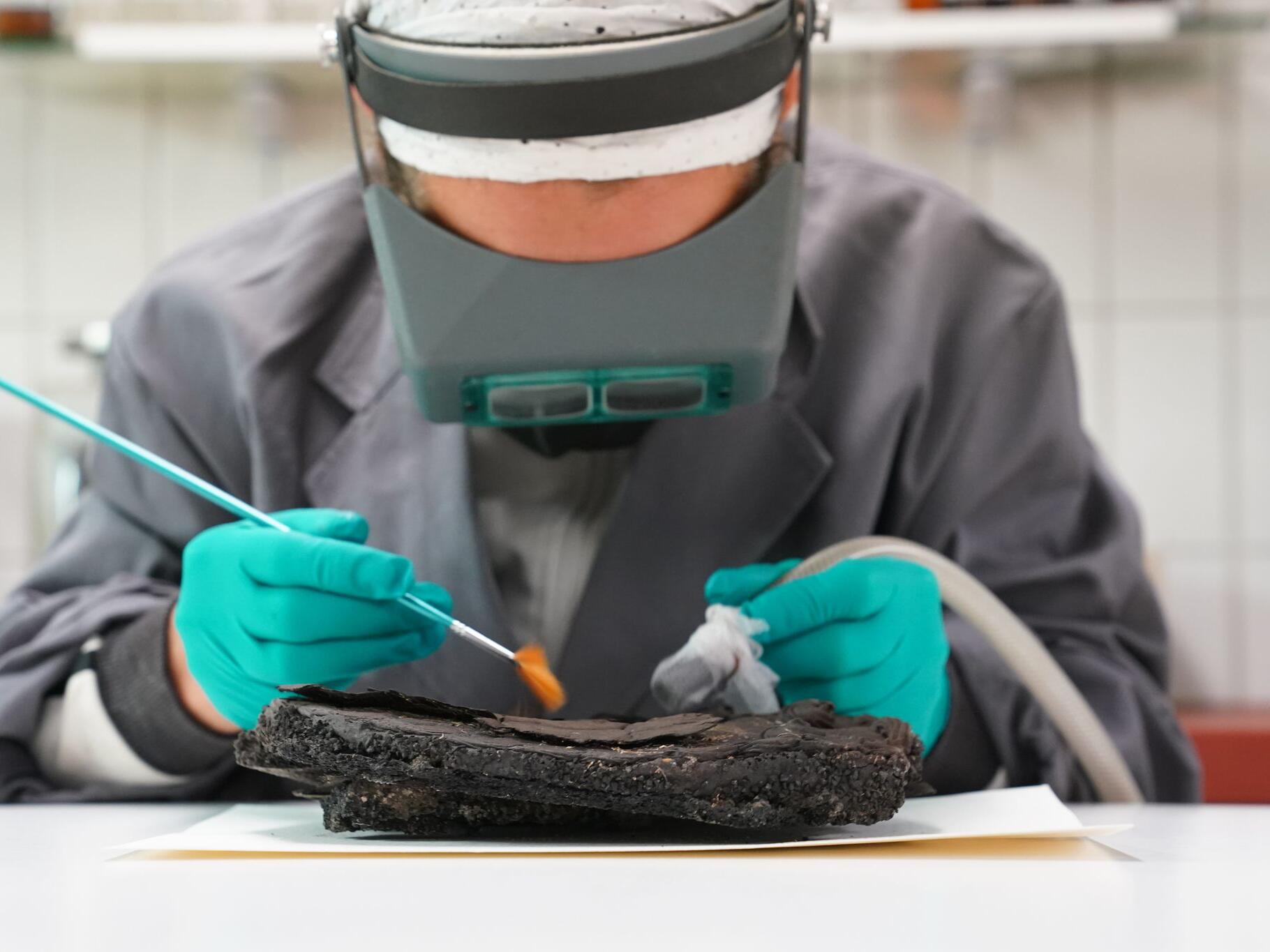
“From the point of view of a restorer, it is the most exciting object that I have ever worked on,” says [conservator Sylvia] Morgenstern. “I first have to wait for the laboratory analyzes. Only then can I decide whether I can clean the find with water and which substance is suitable for stabilization,” she says.

But just like the question of preserving the cake, the archaeologists are concerned with the story behind it. In addition to the charred cake, a coffee service and several records were also found. “Possibly the pastry was intended for a confirmation ceremony. It used to take place on Palm Sunday,” said Schneider. “We hope that we can clarify this with the help of the city archives at some point.” […]

“The cake find is so special because it goes back to an event – namely the bombing raid on Lübeck – that is still present in the minds of the city,” says Doris Mührenberg, who is in charge of the Lübeck Archeology magazine. This is where the “cake mummy” will later find its place – if it is possible to preserve it permanently.

Share


from The History Blog https://ift.tt/3tXkvRC

‘Cake mummy’ survived WWII bombing of Lübeck

A hazelnut cake complete with swirls of frosting carbonized in the bombing of Lübeck in 1942 has been discovered in a cellar in the city’s historic old town. No food preserved in the firestorm of the bombing has been discovered before in Lübeck. Nor are there any comparable survivors from Hamburg or Dresden, two other German cities that were famously devastated by Allied firebombing.

City archaeologists unearthed the cake in April during an excavation under a house on the Alfstrasse, a street that leads from the Trave river to Lübeck’s iconic 13th century St. Mary’s Church. Built in 1159, barely 15 years after the city’s founding, Alfstrasse is one of the oldest streets in the Lübeck located in the very heart of the city’s founding district.

Lübeck was bombed by the Royal Air Force the night of March 28-29th, 1942, and the fires that resulted destroyed large parts of its medieval city center. St. Mary’s was all but levelled (it was reconstructed after the war), as was the merchants’ quarter. The house on Alfstrasse was destroyed in the bombing, but by a miraculous cake-preserving fluke, a cavity formed under the rubble that insulated the dessert from annihilation in the fires or from being crushed in the house’s collapse.

“From the point of view of a restorer, it is the most exciting object that I have ever worked on,” says [conservator Sylvia] Morgenstern. “I first have to wait for the laboratory analyzes. Only then can I decide whether I can clean the find with water and which substance is suitable for stabilization,” she says.

But just like the question of preserving the cake, the archaeologists are concerned with the story behind it. In addition to the charred cake, a coffee service and several records were also found. “Possibly the pastry was intended for a confirmation ceremony. It used to take place on Palm Sunday,” said Schneider. “We hope that we can clarify this with the help of the city archives at some point.” […]

“The cake find is so special because it goes back to an event – namely the bombing raid on Lübeck – that is still present in the minds of the city,” says Doris Mührenberg, who is in charge of the Lübeck Archeology magazine. This is where the “cake mummy” will later find its place – if it is possible to preserve it permanently.

Share


source http://www.thehistoryblog.com/archives/62298

Am I my heroines?

Anne here, and today I'm responding to a question from Quantum (for which he's won a book): "When reading your books I often wonder whether you imagined yourself as the heroine while writing, imbuing her with qualities that you have or would like to have. Daisy the seamstress is a favorite and perhaps you are stitching ideas together like Daisy making dresses."

1EmmaWatsonHeroineI had to really think about this. When I'm writing, I try to imagine myself into each of the characters — not that the characters are me in any way, but that to access them, I have to 'dream' my way into them and how they are feeling, thinking etc. But it's not much different to the way I imagine myself into the places in the books, when I haven't been able to visit them in person. 

It's a common belief that writers base their characters on real people, but all I can say is that it's not true for me at all. The closest I get to using real people in my books is pinching their name for characters, and I only do that with friends' names and then only for minor characters. (For instance, Sir Alan and Lady Reynolds who give a party in The Scoundrel's Bride. See also who I dedicated the book to.) I also borrow physical characteristics from actors sometimes, but mainly it's the mood of the photo that inspires me, like the one above.

ScoundrelsDaughterMed2

When I was first published a good friend who loves psychology examined my first book with an assumption that the heroine was some form of me. She was a little perplexed. Then she read the second book, and then the next, still looking for me-as-character. I'm not sure when she gave up looking for evidence that they were some version of me, but she did quite early on. 

There is obviously some part of me in all my characters — they come from my imagination, after all. Some have my sense of humor, some respond to the events and situations in the book as I might, but mostly my characters do and think things I would never do. Occasionally they do things I would love to be able to do — like come up with instant snappy comebacks in dialogue. In real life I often only think of the perfect comeback an hour or two later, or even at 2am. But generally they are who they are. Other writers I've talked to about this have similar responses — I suppose it's where the notion of "a muse" comes from.

Some of my main characters spring to life more or less fully formed on the page. Others take longer to emerge, and I ask myself questions about them, and what they are feeling at any point in the story. I build up a picture in my mind of who they are and what makes them tick. Even then, some can surprise me.

Cover-spring-brideI remember when I was writing The Spring Bride, and Jane said to Zachary Black — "Oh grow up!" In the scene she and the hero are arguing over her decision to make a practical marriage. Up to that point she'd been sweet and cooperative and her spurt of temper took me as much by surprise as it took Zachary. I know that sounds weird, when Jane was my creation, but one of the joys of writing is when a character takes on a life of their own. 

And some readers wrote to me, saying how much they liked that point where, to quote a couple of them, "Jane grew a backbone." 

Here's that scene:

“You make it sound so cold-blooded, and I’m not,” Jane said.

He laughed, a short, hard sound. “Yes you are. Still, you deserve better than a fellow like Cambury. You can’t let yourself be sold off like this—”

“Oh, grow up!” she snapped.

His jaw dropped. “What?”

“I said grow up! Oh, it’s all so easy from where you stand, isn’t it, Mr. Black? You look at me and see the fine clothes, and you see I’m living in a big house in the best part of town and you imagine it’s all so perfect, don’t you?”

“I—”

“You can’t possibly imagine—can you, Mr. Black?—that I might know what it is to be hungry, what it is to be cold, what it is to have nowhere safe to sleep at night—” She broke off and took a deep, steadying breath.

“I didn’t—”

“I have nothing, not a penny of my own but the allowance Lady Beatrice gives me—and she has no reason to give it—I am no kin to her. It is nothing but kindness—charity, if you will.” Her eyes glittered with unshed tears. Angry unshed tears.

“I have little education, no skills, nothing but my face to recommend me. Lady Beatrice has given me the opportunity to make the kind of marriage that will secure my future—mine and any children I might have—and neither you, nor anyone else, is going to stop me from having it, no matter how much I might—” She broke off, shaking her head. “Oh, please, just go. And don’t come back. I don't wish to see you ever again.”

 *   *   *   *   *

Jane isn't the only character who has surprised me with something they said or did, or behaved differently from how I'd initially imagined them, but I won't bore you with endless examples. I will say, however, that the surprise often comes in a scene where I'm handwriting first (which I don't always do) so I guess my subconscious is kicking in. And when that happens, it's a real boost.

SmoulderingDuke

But rather than characters that are some version of me or even of someone I know, I would much prefer to write the kind of characters I would love to meet, characters who surprise and entertain me — like Lady Beatrice, for instance, the kind of woman who we'd never meet in life.

So in a way you're right, Quantum — I am a bit like Daisy the dressmaker. Sometimes the character (or in her case, the dress) comes to me wholly imagined, and other times, it comes of draping and pinning and snipping and trying out different fabrics and styles until the right one emerges. Thanks for the question.

Question for readers: Have you ever come across a character in a book who reminds you of someone you know? Do you like it or does it feel a bit weird? Or is there a character in a book that you'd love to meet, because they're nothing like the people you meet in real life?


source https://wordwenches.typepad.com/word_wenches/2021/09/am-i-my-heroines.html

Tuesday

Medieval Mass Graves Excavated in Lebanon

POOLE, ENGLAND—Two mass graves thought to contain the remains of European soldiers killed during the Crusades have been found in a dry moat at the site of Lebanon’s St. Louis Castle, according to a Live Science report. Christian soldiers first captured St. Louis Castle after the First Crusade in 1110, and held the port of Sidon for more than a century. But records also show that the castle was attacked by Mamluks in 1253 and the Mongols in 1260, when it was destroyed. The men in the mass graves, which have been dated to the thirteenth century, are thought to have been killed during these attacks. Richard Mikulski of Bournemouth University said that the chemical composition of the men’s teeth and analysis of DNA samples indicate that some of them were born in Europe. Many of the brutal injuries had been inflicted from behind, and perhaps from horseback, he explained. Piers Mitchell of the University of Cambridge added that a Frankish belt buckle found in one of the graves supports Crusader records, which state that King Louis IX of France, who was on crusade in the Holy Land in 1253, visited the site and personally helped bury the dead. To read about how archaeologists are investigating the history of the Crusades and uncovering surprising facts about the Knights Templar and the spectacular castles built by the Crusaders, go to "Reimagining the Crusades." 

Three Phases of Wooden Wagon Way Uncovered in Scotland

EDINBURGH, SCOTLAND—BBC News reports that three layers of wooden tracks constructed for the horse-drawn Tranent Waggonway have been uncovered in East Lothian by researchers from the 1722 Waggonway Project. The line was first built in 1722 to haul coal along a two-mile route from a pit in Tranent to the coast of the Firth of Forth at Cockenzie and Port Seton, where it was used as fuel for making salt. The distance between the two rails was initially set at about three feet, three inches apart, and was expanded to four feet across in the second phase, between 1722 and 1725, when cobbles were also set between the rails as a path for the horses. The third phase of construction lasted from 1743 to 1744. “The wagonway excavation has shown that these waggonways are far more complex that the single-phase structures previously excavated, and the survival of timber on site including joints, helps us further understand the construction of these early railways,” commented railway historian Anthony Leslie Dawson. To read about DNA analysis of remains dating to the thirteenth through fifteenth centuries interred in a peculiar Scottish grave, go to "Heads of the Family."

Rare Shell Artifacts Discovered in South Australia

ADELAIDE, AUSTRALIA—According to a statement released by Flinders University, modified freshwater mussel shell objects have been recovered from shell middens along south-central Australia’s Murray River by researchers from Flinders University and Griffith University, in collaboration with the River Murray and Mallee Aboriginal Corporation and the Ngarrindjeri Aboriginal Corporation. The shells range in age from 6,000 to 600 years old. Two of them had been perforated, and one has a finely serrated edge. Ngarrindjeri archaeologist Chris Wilson explained that accounts from Aboriginal elders who lived along the Murray River indicate that the perforated shells could have been used as ornaments, for tool stringing, and for fiber scraping, while the serrated shell could be evidence of experimental tinkering, or it may have also been used as an ornament or a food utensil. To read about newly discovered rock art panels that illustrate how ancient Aboriginal Australians envisioned their creation, go to "Letter from Australia: Where the World Was Born." 

Burned Layer at Jamestown Linked to Bacon’s Rebellion

JAMESTOWN, VIRGINIA—The Virginia Gazette reports that new excavations at the site of the memorial church at Jamestown have uncovered intact burn deposits and several artifacts. The burned surface is thought to date to Bacon’s Rebellion in 1676, according to archaeologist Sean Romo, who first spotted burned deposits just below the surface of the ground at the church in 2019. He thought the deposits could be evidence of Nathaniel Bacon’s siege of Jamestown, the fire that burned the fort in 1608, or the retreat of Confederate troops in 1862. “We expected this space to be disturbed in some way, but once we took off the modern deposits, we were shocked. The fact that this site is really intact is incredible,” he said. The artifacts on top of the burn deposits include window leads dated to the period just after the 1676 fire. An investigation along the church’s eastern wall also found evidence of the construction of the brick church tower after the fire. “We have positive evidence of Bacon’s Rebellion and the burning that took place,” explained Dave Givens, Jamestown’s director of archaeology. “The nice thing about this dig is that, as it evolves, it will help us understand more about the layers and what we’re seeing every day.” To read about about work by archaeologists and tribal community members to document the traditional homeland of Virginia's Rappahannock people, go to "Return to the River." 

Burned Layer at Jamestown Linked to Bacon’s Rebellion

JAMESTOWN, VIRGINIA—The Virginia Gazette reports that new excavations at the site of the memorial church at Jamestown have uncovered intact burn deposits and several artifacts. The burned surface is thought to date to Bacon’s Rebellion in 1676, according to archaeologist Sean Romo, who first spotted burned deposits just below the surface of the ground at the church in 2019. He thought the deposits could be evidence of Nathaniel Bacon’s siege of Jamestown, the fire that burned the fort in 1608, or the retreat of Confederate troops in 1862. “We expected this space to be disturbed in some way, but once we took off the modern deposits, we were shocked. The fact that this site is really intact is incredible,” he said. The artifacts on top of the burn deposits include window leads dated to the period just after the 1676 fire. An investigation along the church’s eastern wall also found evidence of the construction of the brick church tower after the fire. “We have positive evidence of Bacon’s Rebellion and the burning that took place,” explained Dave Givens, Jamestown’s director of archaeology. “The nice thing about this dig is that, as it evolves, it will help us understand more about the layers and what we’re seeing every day.” To read about about work by archaeologists and tribal community members to document the traditional homeland of Virginia's Rappahannock people, go to "Return to the River." 

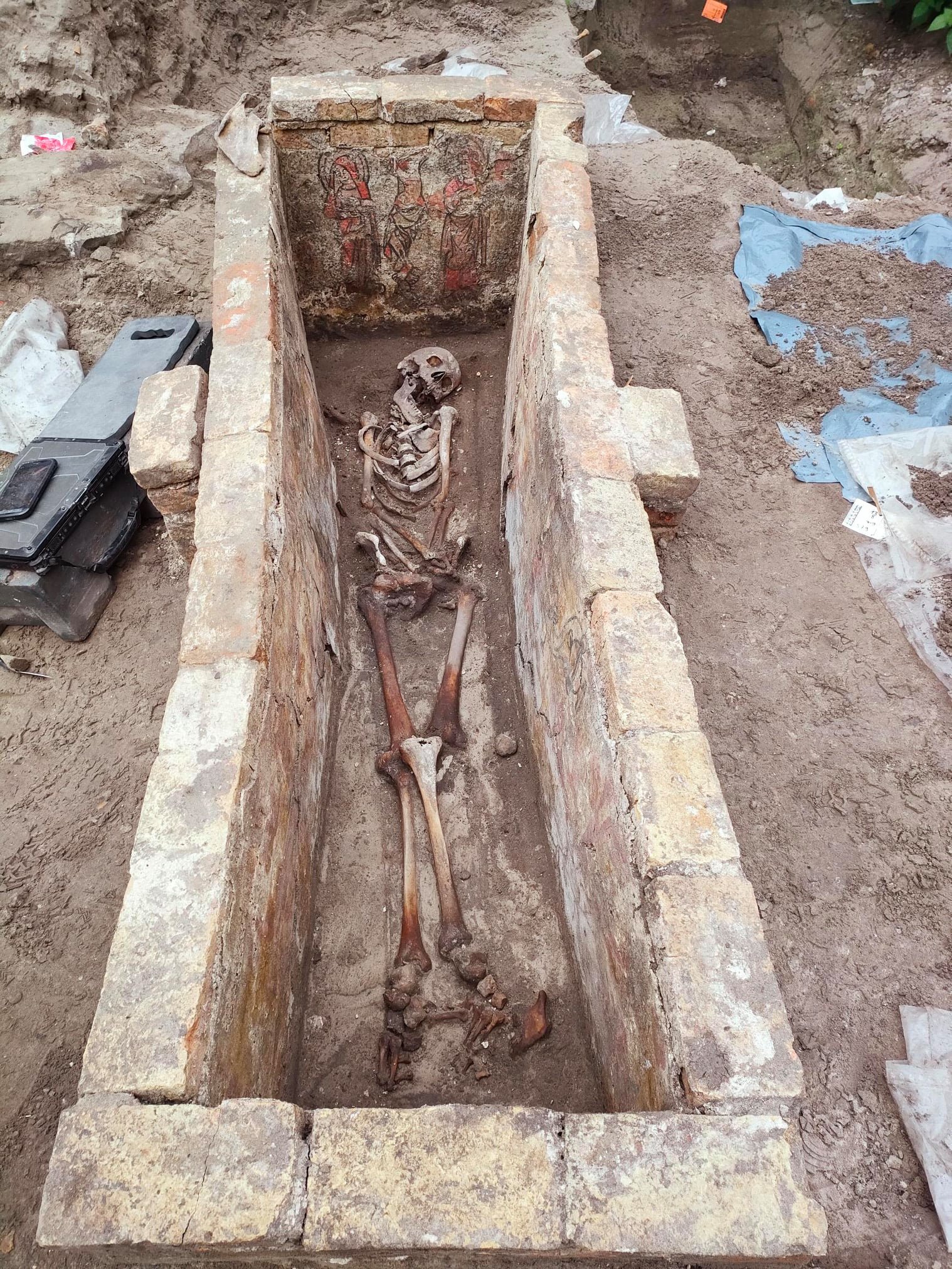
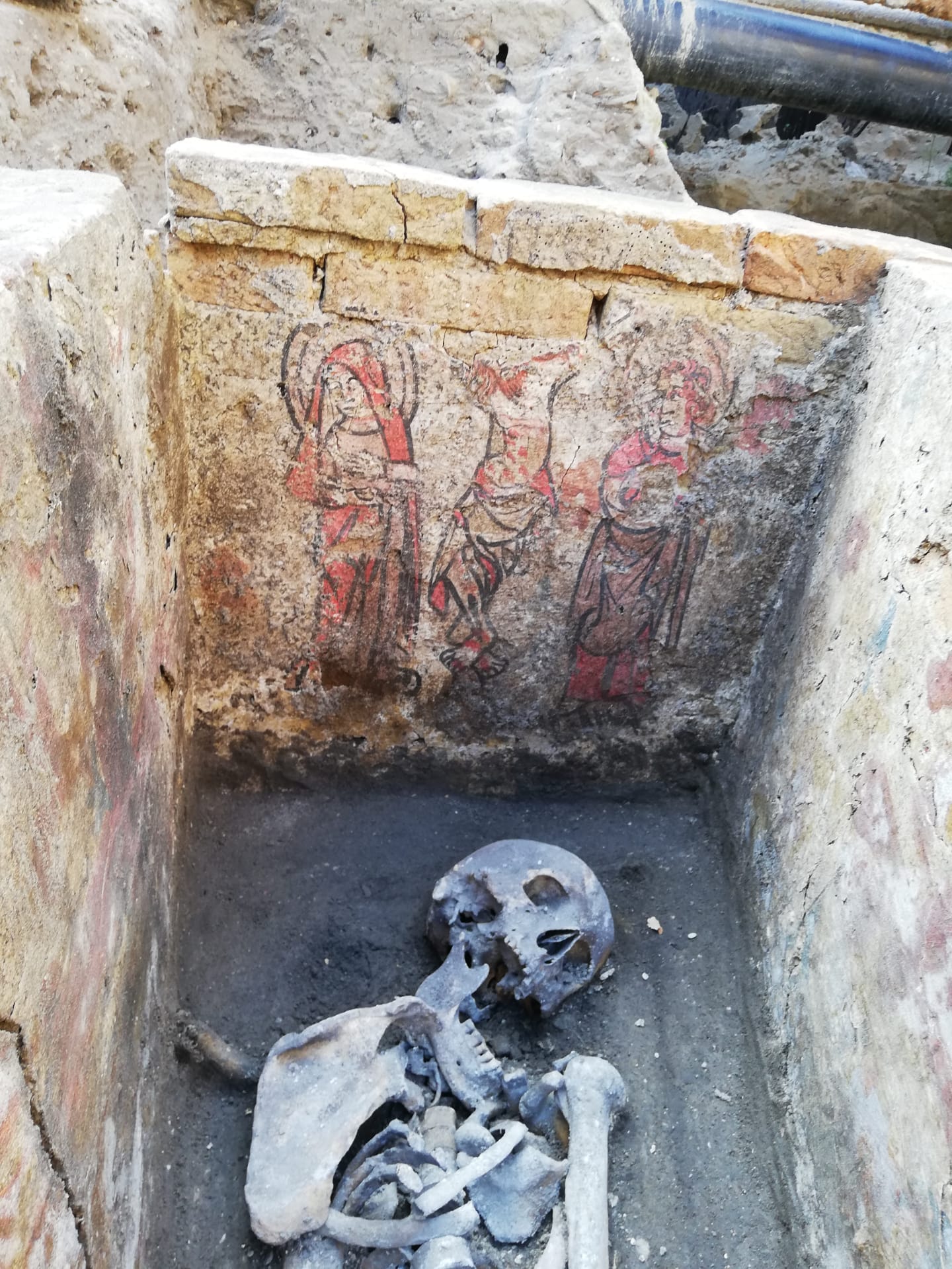
Painted 14th c. burial vaults found in Bruges

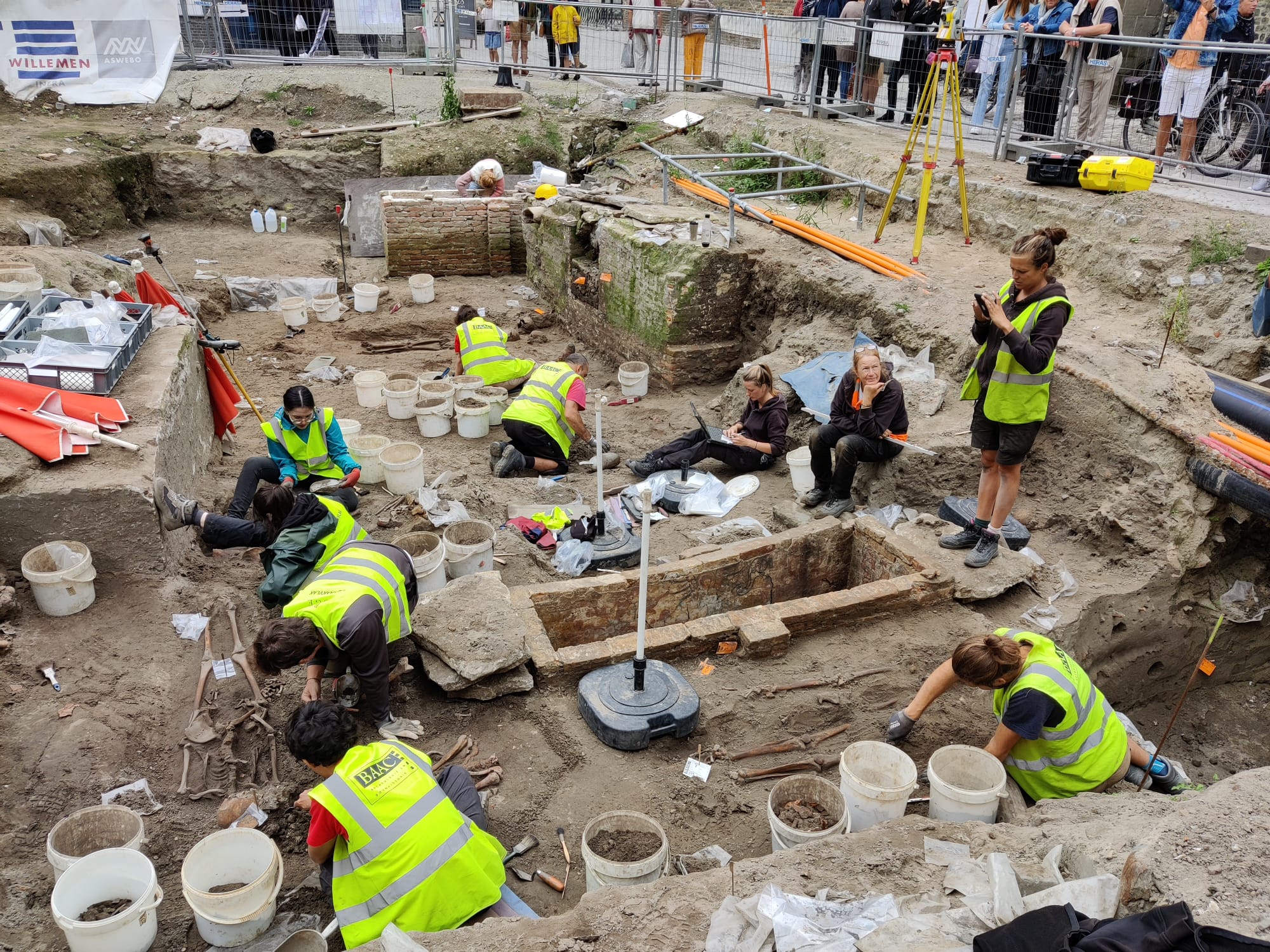
Excavations at the Church of Our Lady in the heart of historic Bruges, Belgium, have unearthed three medieval burial vaults, two of them with painted interior walls. Archaeologists have been excavating the former Onze-Lieve-Vrouwekerkhof cemetery under the Mariastraat, the street in front of the church, since mid-May to recover remains and artifacts before construction of an underground pumping station. Within days the skeletal remains of about 50 individuals were uncovered along with coffin nails from the simple wooden boxes, now decomposed, in which they were interred.

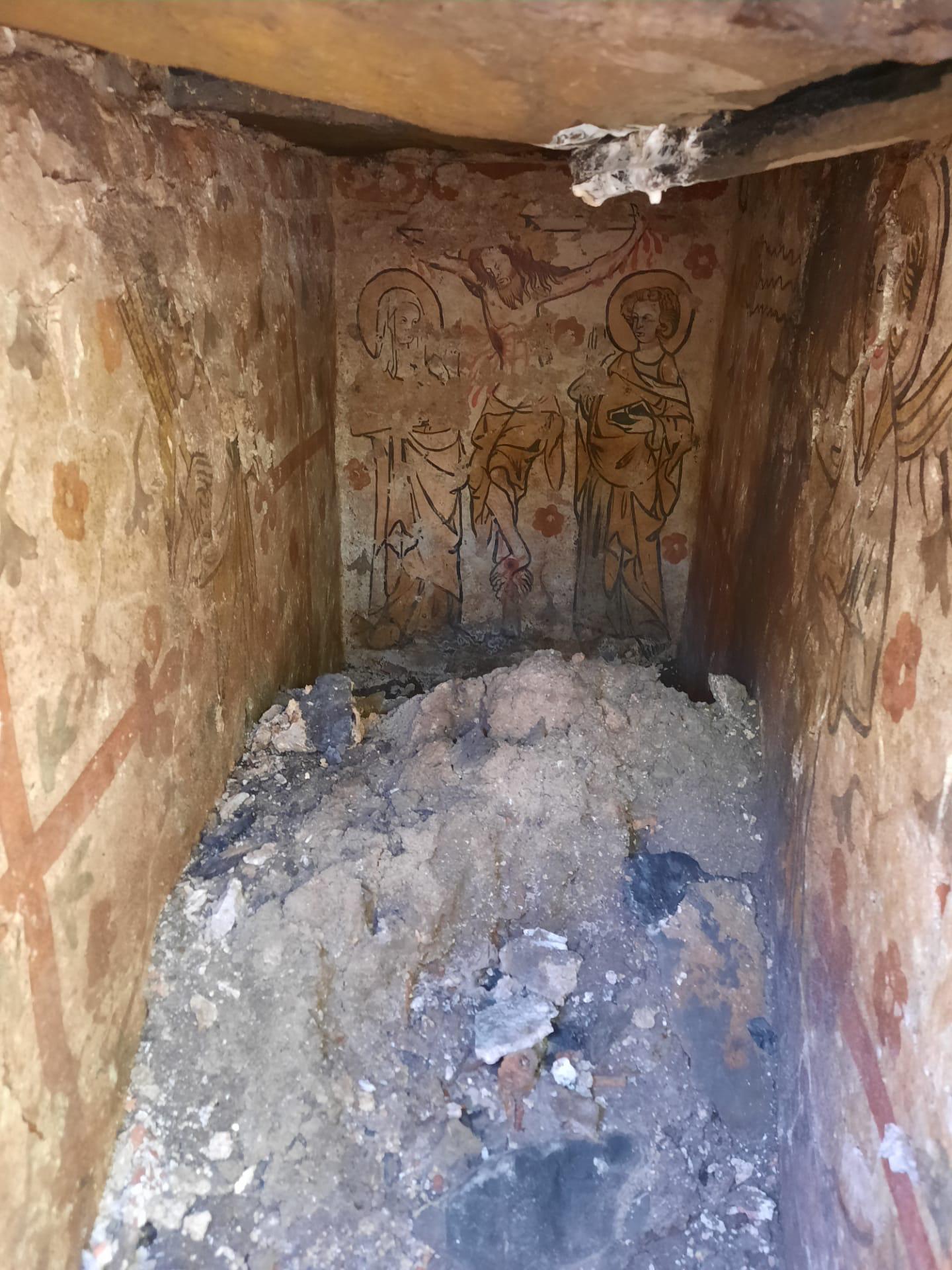
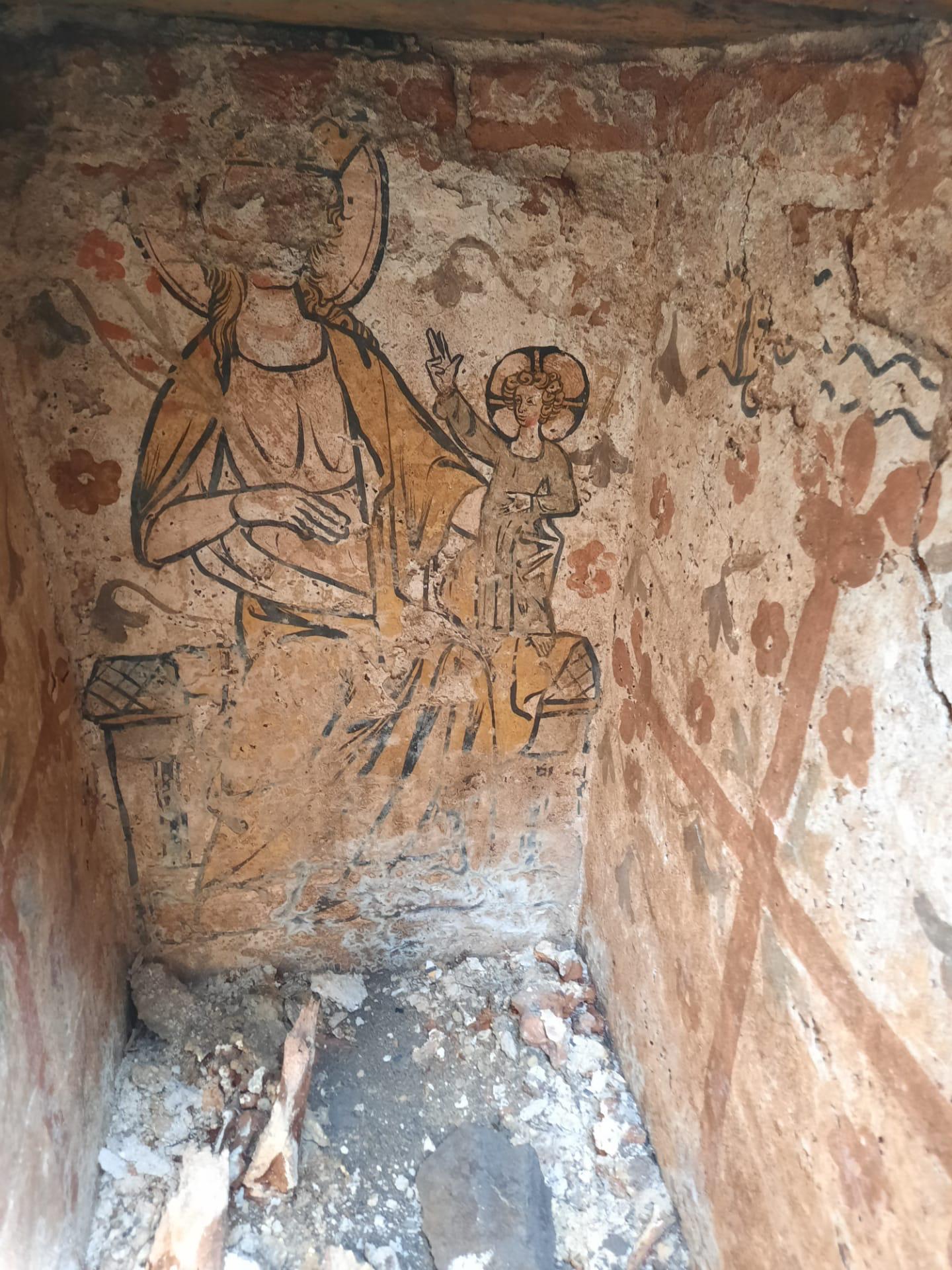
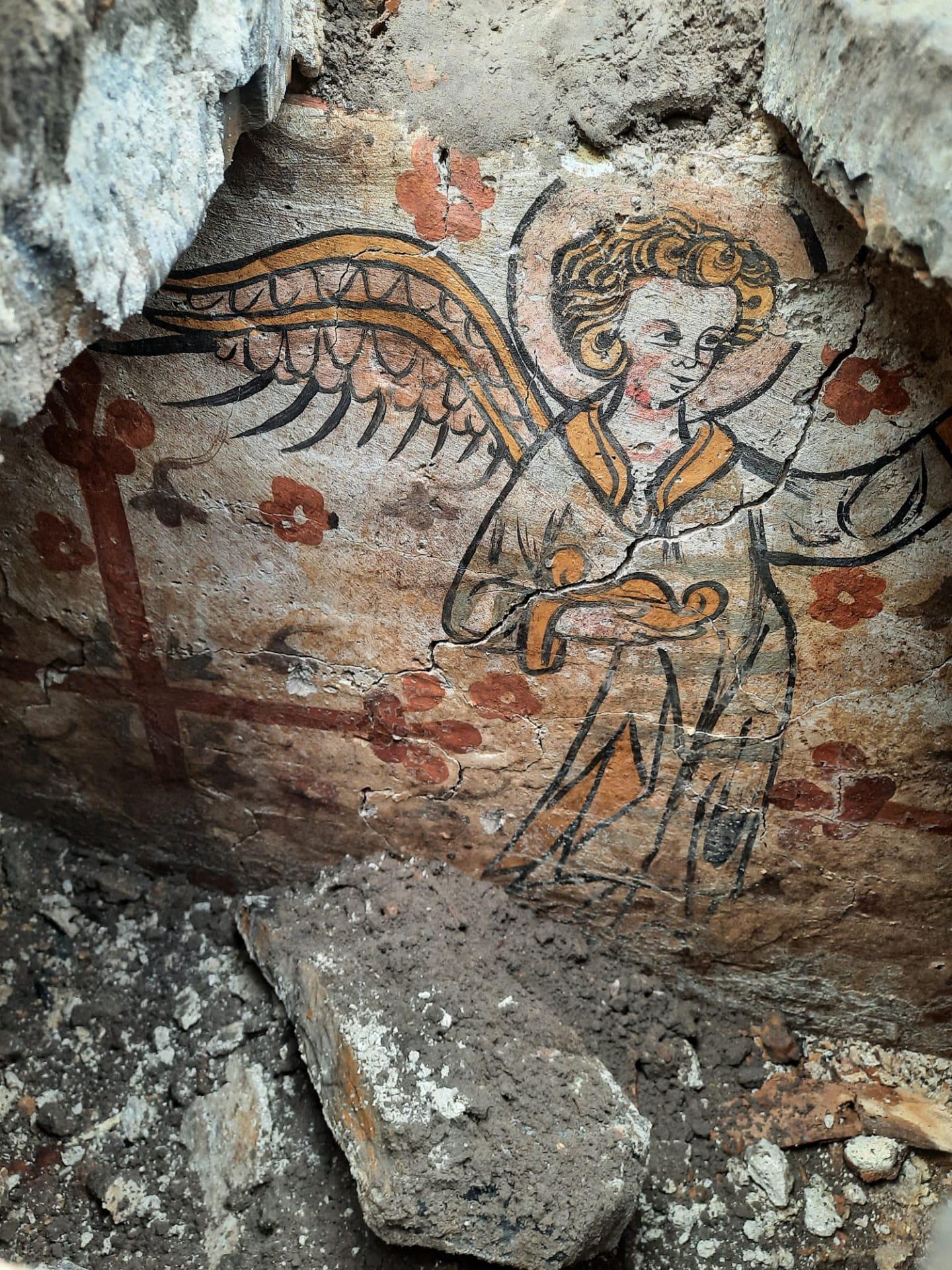
The first two masonry vaults were discovered less than a week into the excavation. One of them was richly decorated with painted murals on the interior walls. Both long sides of the rectangular vault feature angels swinging censers so vigorously they’re horizontal. The short end at the head of the fault is a scene of Calvary — Jesus crucified with his mother Mary standing to his right and the apostle John on his left. Copious blood pours from the nail holes in his hands and feet and from the gaping spear wound in his side. At the foot end is a Sedes sapientiae, Mary enthroned with her arm around the child Jesus by her side. The main figural pieces on all four walls are sprinkled throughout with red flowers and red crosses bottony (a square cross with skinny arms that terminate in trefoils). Based on the painting style, the tomb has been dated to the late 14th century.

The third burial vault was unearthed last week. Its painted interior walls are very similar in style and motif, with angels wielding censers on the long sides peppered with florals and crosses. The short side at the head also features a scene of the Crucifixion, Jesus on the cross flanked by Mary and John, while a Sedes sapientiae decorates the opposite short wall. This tomb also dates to the 14th century, but is likely a little younger than the previous find.

When these vaults were built, they were rush jobs. At that time, bodies had to be buried within 24 hours of death, so bricklayers, masons, plasterers and painters had to make and decorate a vault with a quickness. Because the lime plaster never had the time to dry, the murals painted on the inside were basically frescoes, although not a deliberate choice so much as the exigencies of the situation. The condition of the paint can therefore be challenging. The murals in the first vault discovered are better conserved than the second.

To ensure the best possible preservation of the painted burial vaults, archaeologists called in specialist conservators to clean and stabilize the artworks as quickly as possible so they can be thoroughly photographed and documented. The crypts were then covered back up carefully to prevent damage from the elements. They will remain covered as long as they’re in situ. When the excavation is complete, the vaults will be lifted in their entirety and removed for conservation and study.

A 3D model of the first painted vault has already been completed (see below). A model of the second is in the works. This will allow people to see the vaults and conservators to assess their immediate condition needs without risking any damage to the delicate surfaces.

Share


source http://www.thehistoryblog.com/archives/62282

Painted 14th c. burial vaults found in Bruges

Excavations at the Church of Our Lady in the heart of historic Bruges, Belgium, have unearthed three medieval burial vaults, two of them with painted interior walls. Archaeologists have been excavating the former Onze-Lieve-Vrouwekerkhof cemetery under the Mariastraat, the street in front of the church, since mid-May to recover remains and artifacts before construction of an underground pumping station. Within days the skeletal remains of about 50 individuals were uncovered along with coffin nails from the simple wooden boxes, now decomposed, in which they were interred.

The first two masonry vaults were discovered less than a week into the excavation. One of them was richly decorated with painted murals on the interior walls. Both long sides of the rectangular vault feature angels swinging censers so vigorously they’re horizontal. The short end at the head of the fault is a scene of Calvary — Jesus crucified with his mother Mary standing to his right and the apostle John on his left. Copious blood pours from the nail holes in his hands and feet and from the gaping spear wound in his side. At the foot end is a Sedes sapientiae, Mary enthroned with her arm around the child Jesus by her side. The main figural pieces on all four walls are sprinkled throughout with red flowers and red crosses bottony (a square cross with skinny arms that terminate in trefoils). Based on the painting style, the tomb has been dated to the late 14th century.

The third burial vault was unearthed last week. Its painted interior walls are very similar in style and motif, with angels wielding censers on the long sides peppered with florals and crosses. The short side at the head also features a scene of the Crucifixion, Jesus on the cross flanked by Mary and John, while a Sedes sapientiae decorates the opposite short wall. This tomb also dates to the 14th century, but is likely a little younger than the previous find.

When these vaults were built, they were rush jobs. At that time, bodies had to be buried within 24 hours of death, so bricklayers, masons, plasterers and painters had to make and decorate a vault with a quickness. Because the lime plaster never had the time to dry, the murals painted on the inside were basically frescoes, although not a deliberate choice so much as the exigencies of the situation. The condition of the paint can therefore be challenging. The murals in the first vault discovered are better conserved than the second.

To ensure the best possible preservation of the painted burial vaults, archaeologists called in specialist conservators to clean and stabilize the artworks as quickly as possible so they can be thoroughly photographed and documented. The crypts were then covered back up carefully to prevent damage from the elements. They will remain covered as long as they’re in situ. When the excavation is complete, the vaults will be lifted in their entirety and removed for conservation and study.

A 3D model of the first painted vault has already been completed (see below). A model of the second is in the works. This will allow people to see the vaults and conservators to assess their immediate condition needs without risking any damage to the delicate surfaces.

Share


from The History Blog https://ift.tt/39u5NYF

Monday

Possible Grave of Medieval Christian Hermit Excavated in Spain

BURGOS, SPAIN—According to a statement released by the National Research Center on Human Evolution (CENIEH), a team of researchers has excavated a rock-lined burial placed near the entrance to the San Tirso and San Bernabé Hermitage, a medieval Christian site in Ojo Guareña, a series of caves in northern Spain’s Cantabrian Mountains. Archaeologist Ana Isabel Ortega said the site has been dated to the early eighth century A.D., pushing back the founding of the hermitage by several centuries to about the time of the arrival of Islamic Moors in Spain. The burial is thought to hold the remains of one of the first Christian hermits to live an isolated life in the caves. Ortega and her colleagues will now analyze the chemical composition of the bones and date them to learn more about the individual. To read about the rise of a Visigothic city in Spain amid the collapse of the Roman empire, go to "The Visigoths' Imperial Ambitions."

My notebook and I got drenched and my story was born: an essay by Joanna FitzPatrick, author of The Artist Colony

Joanna FitzPatrick, whose latest novel The Artist Colony is published this month by She Writes Press, is here today with an essay about the research which inspired her fiction.

~

"My notebook and I got drenched and my story was born"
Joanna FitzPatrick

For me, born to travel, research takes me on a journey into the past, and that's why I love writing historical fiction. And it's a journey packed with surprises. Final destination unknown.

After writing an historical novel based on the letters and journals of the short story writer, Katherine Mansfield, which required a strict adherence to her biographical point of view, I looked forward to wandering freely into my next historical novel, creating new characters, and this time I wanted to write a mystery.

After you find an era that appeals to you, mine is the 1920s, one of the joys of research is intentionally falling down rabbit holes to find out everything you can about your subject: Prohibition, women's voting rights, rum runners, suffragettes, artists and artist colonies are some of my favorite subjects. And I feel a tremendous responsibility to my readers to thoroughly know these historical facts before I build a story around them.

As you can tell, I love reading history, but as a fiction writer the real exhilaration comes when I resuscitate history through the characters I create and then let them loose to see how they will behave.

One pathway in my research led me to the history of Asian communities in Monterey. The more I read about how these migrants were punished for their self-reliance and determination to make a good life for themselves in America, I knew my historical novel wouldn't be complete without including their powerful, but tragic voices.

In my research into the Portuguese whalers' and immigrant fishermen's stories, I was particularly intrigued by the Japanese abalone divers, which led me to the amas, women divers who also became characters in my novel.

Once I had embedded myself in Monterey's history, it was time to close those weighty books and head out to where that history took place.

As I entered the creaky wooden door into Whalers Cabin at Point Lobos, I felt my story take hold of me. Whalers Cabin was originally built in the mid-1800s and is currently a historical museum with artifacts and photographs of the many people who came to Monterey from long distances and settled on these shores.

Later, standing outside under the canopy of an ancient cypress, I thought, what if . . . and my plot began to percolate. My imagination on fire, pencil in hand, my fingers wrote down my ideas as quickly as I came up with them.

In my own cloud, I wasn't aware of the approaching storm until the heavy clouds burst overhead. It was my first shoreline squall and its dramatic energy added to my own excitement. While my notebook and I got drenched, my story was born.

When the sun broke through and the rain stopped as quickly as it had started, I took the trail outside Whalers Cabin to the unmarked Kodani Village. Gennosuke Kodani, a Japanese abalone diver, made his home on a bluff above Whalers Cove and he caught and canned abalone for a lucrative international market. His Pacific Grove Cannery was built on the opposite side of his village. There are no remnants left of the Kodani Village. But there are sepia photographs of his home, guest houses, bunk rooms, and Japanese women drying abalone on racks. It was easy to put my character Sarah on the bluff watching the women work and smelling the stinky abalones.

Reading history is not always a delicious piece of cake. Historical facts can be heartbreaking when doors open into the past where dark forces are released. In my research, horrible facts were exposed that rattled my strong belief in justice for all. These facts could not be ignored. My characters would have to work through the rampant racism in their own community–to ignore these facts would be a different story.

I went back to the drawing board and expanded my research to our country's treatment of Asian immigrants during the early 20th century so I could better understand the blatant discrimination in this idyllic artist colony on the Pacific shore. These facts would force my characters to question their own humanity. And because of this expanded research, what started out as a plot-driven mystery became a character-driven historical novel with an element of mystery.

I had started The Artist Colony journey before the COVID-19 pandemic, but as I was working on the last revisions, events took place outside my writing studio that linked my hundred-year-old story to the racial discrimination happening today.

I know I don't have the power to change the course of history, but perhaps the readers of The Artist Colony might choose to question their own humanity so that a writer a hundred years from now won't be telling the same story I wrote, because it's true: Those who don't know history are destined to repeat it.

~

Joanna FitzPatrick
(credit: Michelle Magdalena)
Joanna FitzPatrick was raised in Hollywood. She started her writing habit by applying her orange fountain pen and a wild imagination to screenplays, which led her early on to produce the film White Lilacs and Pink Champagne. Accepted at Sarah Lawrence College, she wrote her MFA thesis Sha La La: Live for Today about her life as a rock ’n’ roll star’s wife. Her more recent work includes two novels, Katherine Mansfield, Bronze Winner of the 2021 Independent Publisher Book Award (IPPY) in Historical Fiction, and The Drummer’s Widow. The Artist Colony is her third book. Presently, FitzPatrick divides her time between a cottage by the sea in Pacific Grove, California and a hameau in rural southern France where she begins all her book projects. Find her online here:

Author website: www.joannafitzpatrick.com
Facebook: www.facebook.com/JoannaFitzPatrickauthor
Twitter: https://twitter.com/Fitzpatrick_jo
Instagram: https://www.instagram.com/joannafitzpatrick.author/


from Reading the Past https://ift.tt/3EAfp2A

Executive Real Estate Business Class