800-Year-Old Tomb Discovered in Peru

LIMA, PERU—The remains of eight people estimated to be 800 years old were discovered by workers laying gas pipes near Lima, according to an ...

Monday

Woman buried with heavy bronze jewelry found in in Siberia

The remains of a woman buried with a rich array of heavy bronze jewelry have been unearthed in what is now the  Republic of Khakassia, southern Siberia. The intact grave was discovered in the Askiz-17 burial ground and dates to the 8-10th century B.C.

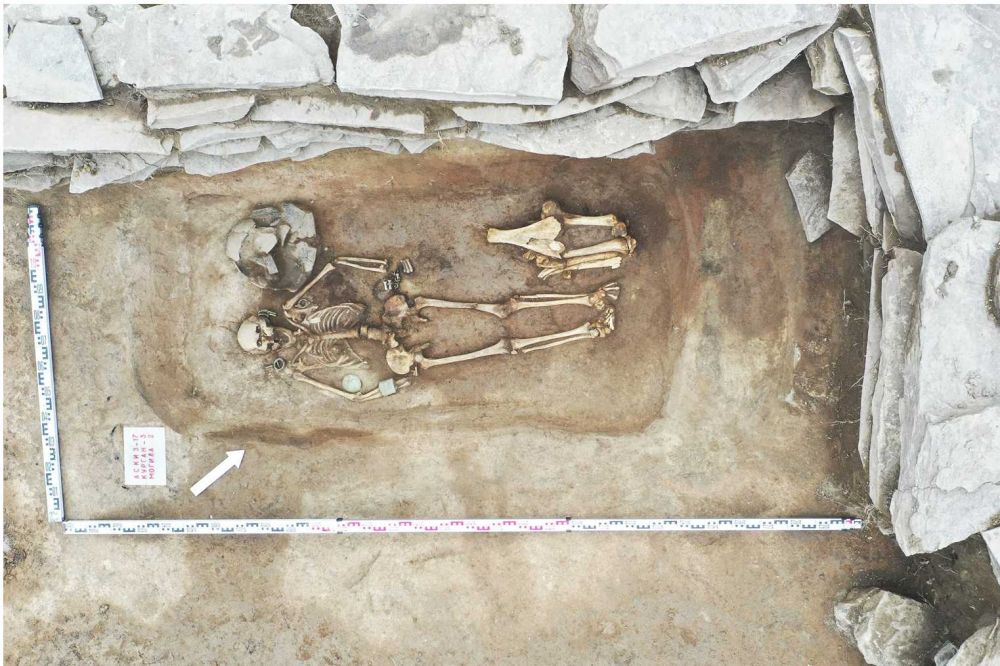
She was found in a small, relatively shallow burial pit attached to the western side of a stone mound whose central grave had been pillaged centuries earlier. Only 30 inches deep, the pit managed to avoid being damaged or destroyed by the construction of highways and railroads that has taken a heavy toll on the visible structures of the prehistoric burial ground.

The woman was placed in a supine position with her head in a southeastern orientation. Animal remains — the shoulder blade and front leg of a large horned mammal — were tidily placed to the side of her left foot as funerary offerings. The broken blade of a bronze knife was laid next to them. A large round pottery vessel with an ornamented rim was placed next to her head. It is in fragments, smashed over time by the stone filling of the burial pit.

The bones are in poor condition, but they are still for the most part articulated in their original anatomical order. It is what her bones are wearing that identifies her as part of the Karasuk culture, skilled metal workers renown for their high-quality bronze cast in wax.

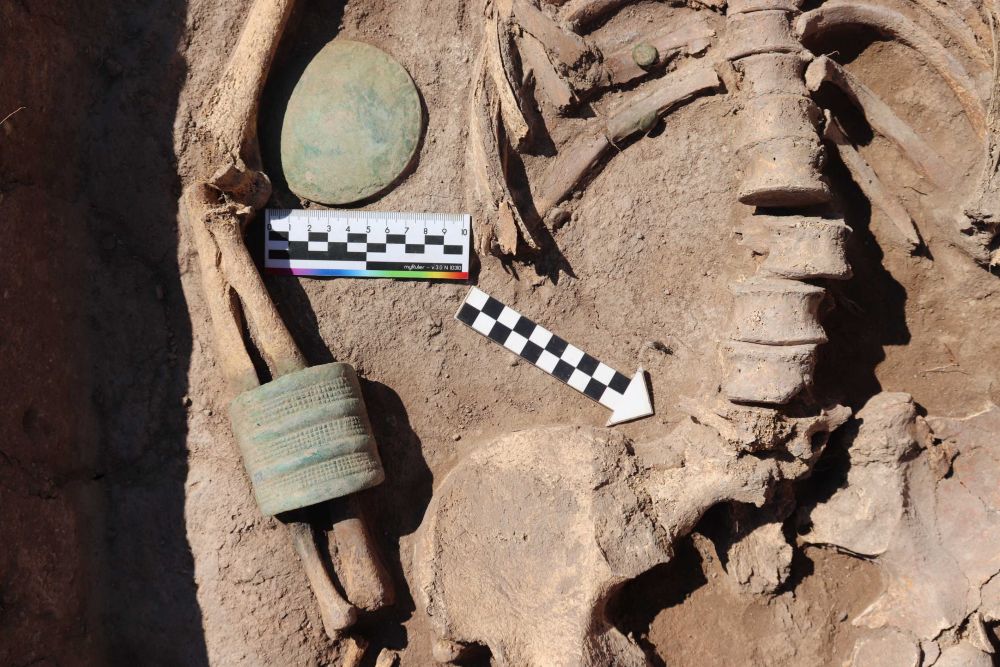
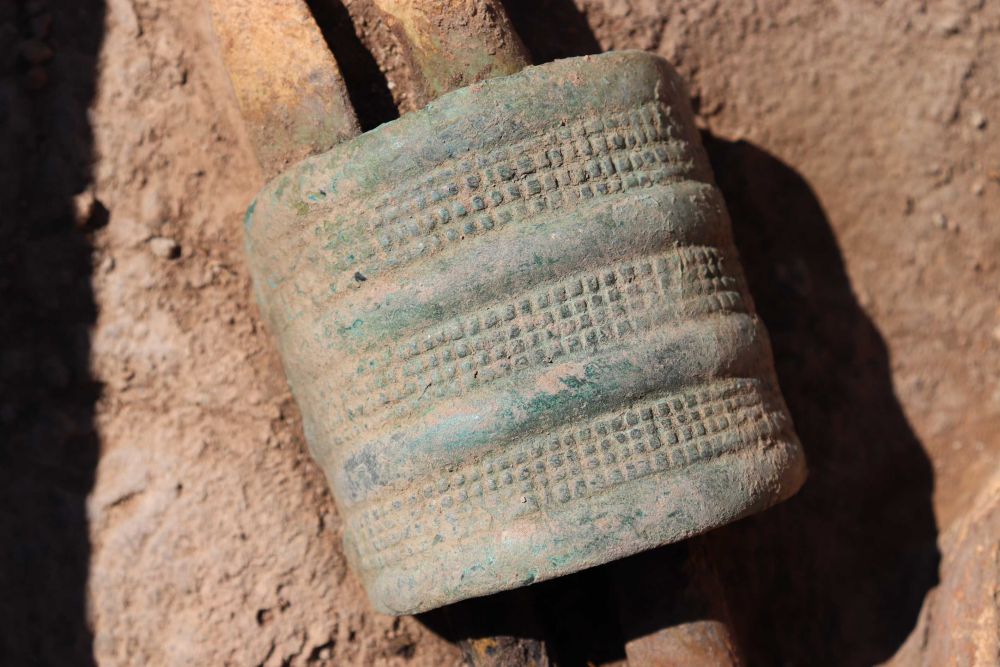
A large bronze bracelet with checkered ornament was placed above her wrist, four fingers of her left hand had large bronze rings, each with two pearl-shaped bronze decorations.

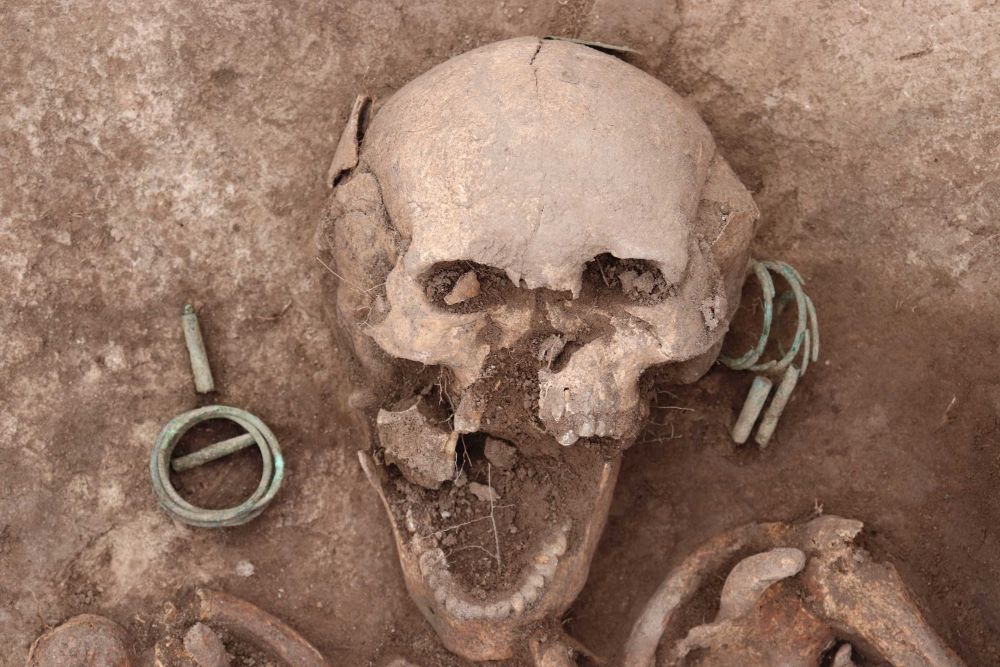
To each side of the woman’s skull were 3 temple rings; two triangle plates were next to her head.

By her right elbow archeologists found a round bronze plate, 9 centimetre in diameter, and 8 small bronze buttons.

Archaeologists believe this was a custom-made funerary set, not jewelry the woman would have worn during her lifetime. There are no signs of wear and tear, not even the small scratches you’d expect from any kind of use at all. The sheer weight of the jewelry would have made them uncomfortable and unwieldy to wear under regular ambulatory circumstances.

All pieces from the small buttons, which once adorned burial clothes that have long-since decomposed, to the massive bracelet are made in the same artistic style typical of the the Minusinsk Basin in the Late Bronze Age. They were likely cast to order from one foundry. Her entire outfit, clothes and jewels, was a matched set created by a single master bronzesmith to send the deceased off in a style befitting her wealth and high status.

Share


source http://www.thehistoryblog.com/archives/62271

Woman buried with heavy bronze jewelry found in in Siberia

The remains of a woman buried with a rich array of heavy bronze jewelry have been unearthed in what is now the  Republic of Khakassia, southern Siberia. The intact grave was discovered in the Askiz-17 burial ground and dates to the 8-10th century B.C.

She was found in a small, relatively shallow burial pit attached to the western side of a stone mound whose central grave had been pillaged centuries earlier. Only 30 inches deep, the pit managed to avoid being damaged or destroyed by the construction of highways and railroads that has taken a heavy toll on the visible structures of the prehistoric burial ground.

The woman was placed in a supine position with her head in a southeastern orientation. Animal remains — the shoulder blade and front leg of a large horned mammal — were tidily placed to the side of her left foot as funerary offerings. The broken blade of a bronze knife was laid next to them. A large round pottery vessel with an ornamented rim was placed next to her head. It is in fragments, smashed over time by the stone filling of the burial pit.

The bones are in poor condition, but they are still for the most part articulated in their original anatomical order. It is what her bones are wearing that identifies her as part of the Karasuk culture, skilled metal workers renown for their high-quality bronze cast in wax.

A large bronze bracelet with checkered ornament was placed above her wrist, four fingers of her left hand had large bronze rings, each with two pearl-shaped bronze decorations.

To each side of the woman’s skull were 3 temple rings; two triangle plates were next to her head.

By her right elbow archeologists found a round bronze plate, 9 centimetre in diameter, and 8 small bronze buttons.

Archaeologists believe this was a custom-made funerary set, not jewelry the woman would have worn during her lifetime. There are no signs of wear and tear, not even the small scratches you’d expect from any kind of use at all. The sheer weight of the jewelry would have made them uncomfortable and unwieldy to wear under regular ambulatory circumstances.

All pieces from the small buttons, which once adorned burial clothes that have long-since decomposed, to the massive bracelet are made in the same artistic style typical of the the Minusinsk Basin in the Late Bronze Age. They were likely cast to order from one foundry. Her entire outfit, clothes and jewels, was a matched set created by a single master bronzesmith to send the deceased off in a style befitting her wealth and high status.

Share


from The History Blog https://ift.tt/3nKKRoR

Birthdays in History

Pancraz_Körle_Die_Geburtstagstorte

 The Birthday Cake, Pancraz Koerle, 1875, private collection

Susan here. September is a busy birthday month in our family, with birthdays from the first week through the last week (and into October) - lots of Virgos and Librans! We're celebrating a special birthday this week, with cake and candles and gifts for this lovely person. And that got me thinking about birthday celebrations through history. Were birthday celebrations as important in other eras as they are today? 

AkhenatennefertitiEven early cultures had ways of noting significant dates and of course marking the significance of births. Some of the earliest refences to birthdays occur in the Bible. In Genesis, an Egyptian pharaoh was said to have celebrated his birthday by “lifting up the heads” of a baker and a few others (let’s assume that meant he liked their cakes and elevated their status, or allowed them to look up in his presence, rather than lopping off heads and lifting them high).

King Herod famously celebrated his birthday by watching the daughter of Herodias, Herod’s wife—often identified as Salomé—dance for him. In return, he rewarded her (thereby giving a gift on his own birthday) by asking her what she most wanted; she asked for the head of John the Baptist. 

It’s unknown whether these ancient references to birthdays marked actual natal days, or the “birth” of the king or the pharaoh on their coronation day. Persian relief sculpture
That’s not always easy for historians to determine. Ancient Persians, according to Herodotus, loved birthdays best of all holidays, and rich and poor celebrated with feasts piled high on their tables, the groaning boards of the wealthy piled higher than modest ones, but both apparently featured lots of meats (this ancient bas-relief shows that Persians really knew how to party).

The Greeks celebrated birthdays by associating them with the goddess Artemis, celebrating her feast on the same day each month, 12 times a year, with mooncakes, or small honeyed cakes, with a candle, as an offering to the goddess. Romans took note of birthdays with prayers and offerings to the gods, perhaps similar to Artemis and her mooncakes, as Roman writers note cakes of wheat and honey, along with cheese and wine—but only for guys. Roman women did not get much attention on their birthdays.  

1200px-A_Dedication_to_Bacchus
Almost certainly, Roman astrologers were casting natal charts for important families, along with horoscopes drawn to support the plans of caesars and other powerful leaders. A second-century Roman astrologer created a global map to accurately determine the position of the stars for a person's place of birth, date, and time as well. Emperor Augustus had an astrologer outline his claim to power, while Tiberius is known to have employed a court astrologer as one of his advisors.

Chinese 13th c met musDetouring to China around the same time, the Chinese favored birthdays with calligraphy and ink sketches to wish the birthday person good fortune and prosperity - and thereby invented the birthday card! 

Astrology continued to develop during the Middle Ages. Arabic court astrologers studied the stars to produce such accurate methods and charts that they are still in use today. In Europe, medieval astrologers learned a great deal about astrology and medicine from the Middle East, and utlized them in the healing arts--physicans and healers often relied on astrological information to understand ailments. While many regarded astrologers as diviners and wizards practicing suspicious arts, astrology and the zodiac were part of the medieval knowledge base. Illuminated manuscripts included astrological illustrations and information right alongside religious content, yet skepticism remained. 

Libra morgan libraryIn the medieval centuries, birth dates were not always as important as the saint's feast day associated with the day, which then became a person's name day. If the birth date was not known, then a given name, if similar to a saint's name, could determine the date. If you were born on a holy day or holiday, you could be named for the day itself—in which case, you'd know your actual birthday. A girl born on the Feast of the Epiphany could be named Theophania (later Tiffany); born on Easter, the name might be Esther or Pascal; born on Christmas, you might be named Christina, Christian, Noel—or even Christmas. As Susan, my name day would be the feast day of St. Susanna, August 11—not my own birthday in October. In one of my books, I named a heroine Michaelmas for her birthday of September 26, that feast day (it worked for the story--Lady Miracle), Michael for short (then as now, male names were sometimes given to girls). English ms zodiac signs

Sometimes the date was known and noted. Chaucer mentions natal astrology in “The Squire’s Tale” --  And so bifel that whan this Cambyuskan Hath twenty wynter born his diademe—“he had the feast of his nativity proclaimed through Sarray, his city, Exactly March 15, in the ordinary course of the year. Phoebus the sun full jolly was and clear, for he was near his position of greatest power, In Mars’ face and in his astrological house of Aries, the choleric hot sign.”

Pancraz_Körle_Die_Geburtstagstorte - CopyMoving along, birthdays lost importance during the age of Protestants and Puritans—one must not call undue attention to oneself! But the 18th century brought back the appreciation of birthdays and the individual, and one's special day might be celebrated with cakes and wine and parties—though that was more likely for royalty and nobility than the less privileged classes. 

By the time of the Regency, it is not entirely clear what birthday traditions existed, but they were definitely regarded as special and worthy. Jane Austen writes to her sister Cassandra to wish her “joy of your birthday twenty times over,” although there are apparently no mentions of birthday parties or gifts in her novels.

Victorian dinner partyThe Victorians kicked the birthday into high gear with presents, cakes, blazing candles, parties, concerts—and in the later Victorian age, beautifully ornate and wildly sentimental cards and postcards sent to the birthday person. Those traditions carried right along into the 20th century and beyond! 

How do you celebrate birthdays—homemade cake, bakery cake, moon cake? Presents and candles and wild parties? Or do you prefer a quiet birthday with family and friends or curled up with a good book?   


source https://wordwenches.typepad.com/word_wenches/2021/09/birthdays-in-history.html

Sunday

Teaching "All Men are Created Equal" (Part II)

Pulling Down the Statue of King George III, N.Y.C., Johannes Adam Simon Oertel ca. 1859, depicts the destruction of a statue of the monarch in the wake of the reading of the Declaration of Independence, 1776.


Note: This is the second part of Jeff Schneider's essay on teaching the content and contradictins of the Declaration of Independence. Part I is here


The assignment for the second day is to find the words where Jefferson discusses revolution and describes government and democracy. Unfortunately even though the idea that “all men are created equal” is the basis of the right to revolution, we will have to put off most of that discussion until the last day. However, here is a key sentence describing the relation between revolution and government:


(T)hat to secure these (natural) rights governments are instituted among men deriving their just powers from the consent of the governed: that whenever any form of government becomes destructive of these ends it is the right of the people to alter or abolish it, and to institute new government, laying its foundation on such principles, … as to them shall seem most likely to effect their safety and happiness.


The causal relationships among natural rights, agency and government are at the heart of the description of the right to revolution. It is these lines that inspired peoples all over the world to take their fate in their hands and overthrow tyrannical rule. It is these ideas that inspired Tom Paine to write in the first edition of Common Sense:


O ye that love mankind! Ye that oppose not only the tyranny, but the tyrant, stand forth! Every spot of the old world is overrun with oppression. Freedom hath been hunted round the globe. Asia, Africa have long expelled her! Europe regards her like a stranger and England hath given her warning to depart. O! receive the fugitive, and prepare in time an asylum for mankind.


On the third day we discuss the meanings of the right to revolution and the paragraph leading to the Grievances and the conclusion, sometimes called the declaration of war. The last lines declare that all the previous ideas and grievances will be defended at all costs.


And for the support of Divine Providence we mutually pledge to each other our lives, our fortunes and our sacred honor.


The fourth day is devoted to an Oprah show in which she interviews the two white and two black descendants of Thomas Jefferson. 


I showed it up to the end of the comment by the great historian Annette Gordon-Reed, who speaks from the audience. It is about halfway through. The discussion is riveting: a real discussion between blacks and whites about race, heritage and truth in history. “All men are created equal” is its background. Students are fascinated by the straightforward exchanges on America's creed and its complexities. Many questions are raised in this discussion including passing for white and the shocking actions of Jefferson, who took the enslaved half-sister of his deceased wife as a concubine when she was a young teenager. The story of Sally Hemings could be a week at least in itself. Oprah is one of the few TV personalities who could make a success out of such a show.


Now we are ready for the last day of Declaration classes in my series. The assignment is for the students to list all the meanings they could think of for “All men are created equal.” Who is equal in the Declaration? The list grows as we talk. First there are the white men over 21 who own property or pay a minimum of taxes. These men comprised the vast majority of the voters in all the states. However were there other groups of people to whom the Declaration was addressed? Let us consider some possibilities. Could George Washington and Thomas Jefferson have fought the war by themselves? All the troops could not come from the elite family members of the Continental Congress. To be sure, the protesters of the 1760s and '70s were essential for the development of the revolutionary movement. They were not voters by and large, yet they were essential to the movement.


If we consider the dates we had discussed during the first class for the Revolutionary War, the first battle was fought in April 1775, and the Treaty with Great Britain was signed in 1783, but the date of the Declaration was July 4th, 1776. One might then ask why the Declaration was written so long after the first battle and before the treaty, or why it was written at all. One purpose, besides recruitment of troops, was to gain support for the war and the organizations in the states and local committees of public safety: enforcing boycotts and discouraging Americans from supporting the Loyalists. In addition the Declaration itself was addressed to the supporters of democracy and opponents of Great Britain around the world. The Americans were declaring that they were equal to all the peoples of the world, including the British people. The line before the Grievances was “(L)et these facts be submitted to a candid world.” The Continental Congress expected honest people and countries all over the world to accept the long list of grievances against the king of Great Britain. France, Spain and Holland eventually gave money and political support to the Americans. Generals and troops from Prussia, France and Poland supported the Revolution.


I should make clear that when we discuss “All men are created equal,” we are on a series of simultaneous tracks. First the clause is part of the natural law argument at the beginning of the document: the Revolution is “impelled” by the laws of the universe. Then it is an element in the relation between the people and the government: Since the government is founded by the people they have the right to “alter or abolish it” when the government threatens their natural rights to liberty and safety. As we saw in the quote above on democracy and revolution, it is their government that they built to “secure” their rights. All men have these rights and the responsibility to defend themselves against tyrannical government.


Thus equality is a law of nature, and a political factor in democracy. Equality is an organizing concept, as we have seen. Finally, equality is a concept that breaks through the prejudices of thousands of years of hereditary rights in Europe.


Now we come to the question of why the king is addressed as “He.” If there were a delay in a response to this question, I asked my students what happens when you are at a large family gathering and, while you are talking to your cousin, you refer to your father as “he.” Some of the students laugh. Some are dumbfounded. As we say in the vernacular of southern Long Island, where I grew up, you would get “slapped upside the head.” Demystifying the king is the key here. During the coronation ceremony in England the king is anointed – in secret – with a holy oil that causes him to attain a status between man and God. He obtains thaumaturgic powers: divine right.  If you are going to have a revolution against the king, he must be a man like anyone else. Calling him “He” strips him of his mystery.


As we have been pointing out since the beginning of this journey through the Declaration of Independence, the clause “All men are created equal” embodies the hopes and some of the worst nightmares of every American. Who was not equal or addressed in the empowering clause for white men? Women, Blacks, most of whom were slaves, and those white men without property. Native Americans were also not included in the so-called equality promoted by the Declaration. It is usually stated that about 6% of the total population could vote. New York, New Jersey, Massachusetts, Pennsylvania and New Hampshire all allowed free black men to vote if they met property requirements which, at least in New York, were higher than for whites. Women of any race could vote in New Jersey if they were widowed or not married, but in 1807 the state changed the relevant clause in their constitution from inhabitants to male inhabitants. More than 40,000 Blacks ran away during the Revolution and by 1800 there were nearly 60,000 free Blacks in the US.  They and their allies frequently petitioned the states for freedom based on the bill of rights of the constitution of Massachusetts, for example, which stated that “all men are born free and equal.” Here are the essential parts of one of those petitions:


To the honorable Counsel and House of Representatives for the State of Massachusetts in General Court Assembled, January 13, 1777:


The petition of a great number of blacks detained in a state of slavery in the bowels of a free and Christian country humbly show … that they have in common with all other men a natural and inalienable right to that freedom which the Great Parent of the heavens has bestowed equally on all mankind.... (We petition) your honors... (to) cause an act of the Legislature to be passed whereby they may be restored to the enjoyments of that which is the natural right of all men – and their children who were born in this land of liberty – not to be held as slaves.


The drama in this cannot be denied. These Black petitioners took only 6 months and 9 days after the signing of the Declaration to demand freedom for themselves.  It was based legally not only on the clause referred to above in the Massachusetts bill of rights, but it also quoted the Declaration's assertion of “inalienable” rights and claimed the natural right of equality for “all man(kind.)” These petitioners changed the meaning of men in “all men are created equal.” It was a verbal act of agency that resulted in a legal ruling that slavery in Massachusetts was unconstitutional, codified under the new Massachusetts Constitution of 1780. The Declaration gave them an opening to claim their freedom; something that the US Constitution later denied them. There are no natural rights written into the Constitution of 1787.


I taught these lessons in class after class for more than 30 years. My students welcomed the explanations and close readings of the founding documents. They were proud of learning from the sources and figuring out the truth about our founding as they read and discussed. They took it as a matter of course that they were learning the history of our country in all its complexity. We later read the Constitution, the Articles of Confederation, the Seneca Falls Declaration, the 4th of July Oration by Frederick Douglass, the speeches and letters of Lincoln, the platform of the Populist Party, the Supreme Court cases of Plessy v. Ferguson, Korematsu v. US,  Brown v. Board of Education, the Inaugural Addresses of FDR and JFK, and Martin Luther King, Jr.'s  Letter from Birmingham Jail. I could not wait to get to class to discuss these great works. It was a privilege to teach. I tried to grab my students by the brain and run. I gave them the documents and we learned together. Race was not the only topic we covered, but it was a frequent subject. I did not confront their prejudices; instead, I had them confront the ideas of our history and how our leaders and ordinary people explained them. We covered strikes from the Lowell Mills to the Great Railroad Strike of 1877 to the sit-downs if the 1930s. We read the obituary of one of the survivors of the Triangle Fire and an article by a leader of the of the garment workers. We watched sections of  “Eyes on the Prize,” where they learned that agency was a way of life for the Civil Rights workers.


Over time students will see that there are alternative ways of looking at the world different than the one in which some of them grew up. Eventually they can come to understand that racism is virulent and dangerous to peace in society and physically dangerous to Blacks, Hispanics, Asians and Indigenous peoples in the US. I taught American History with all its flaws. It is not impossible, but it takes intellectual effort and trust that your students can understand and learn how to think for themselves.


The Declaration is complex. It contains soaring rhetoric and grievances that can pull at your heartstrings and a call for equality that can make you want to believe every word. But it is also riveted to and riven by slavery and hypocrisy. The idea that these slaveholders and their non-slaveholding allies were calling for freedom in the name of a humanity that was so narrowed by race, religion and wealth is appalling. Yet it is still a powerful document even when we understand the context: the contradictions of the real lives of the people and the undemocratic character of the government of the United States. Nevertheless we can face all this in class without blaming our students or their parents for the sins of our Founding Fathers.


from History News Network - Front Page https://ift.tt/3EvwEC1

Psychologically Speaking, Who Were the Heads of the Chinese Communist Party?


An individual leader’s lifelong socialization is also critical to understanding their behavior. It is well established in the fields of psychiatry, psychology, social psychology, psychohistory, political psychology, and psychopathology that pre-adult and early adult socialization are critical formative periods that do much to shape how a person behaves throughout their life. In particular, at least the following experiences and relationships have been identified as key influences: where one grows up and their standard of living; relationships with mothers and fathers; degree of maternal nurturing (or lack thereof); experiences in school and relationships with teachers; and relationships with peers. All of these encounters usually have far-reaching impacts on subsequent personality development. For example—for boys—maternal nurturing, a secure home environment, interactive siblings, financial stability, supportive primary and secondary school teachers, and inclusivity with a network of peers can all lead to a secure ego, confidence, and an outgoing adult personality. Conversely, antagonistic relations with fathers, a sense of neglect from mothers or abandonment by parents (even if they are away from home working), bickering with siblings, financial instability, harsh discipline from teachers, exclusion by peers—these experiences can all lead to an alienated, frustrated, angry, repressed, aggressive, insecure, insular adult personality type. This latter type is frequently associated with the development of strong anti-authoritarian and frequently narcissistic adult personality types. These two sets of general pre-adult characteristics have also been found across multiple national-cultural environments and are not simply characteristics of modern Western societies. Indeed, in pre-modern agrarian or early industrialized societies they are quite common.


To what degree do these early family rearing and socialization features shed light on the five leaders covered in this study? One interesting commonality is that only one of the five (Jiang Zemin) grew up in a close-knit and stable nuclear family environment. All the others had very disrupted youths with absent or deceased parents.


Mao and his father had very strained relations, they clashed frequently, and Mao’s anti-authority persona has been attributed to his deep antagonistic relationship with his father. His father made Mao work in the fields beginning at age six, something he resented. As Mao described his father in an interview with Edgar Snow in Yanan in 1937 (his only known reflection on his youth and family): “He was a hot-tempered man and frequently beat both me and my brothers.” Mao told Snow that he grew to “hate” his father. Being unfilial toward his father, in such a patriarchal traditional culture, gave Mao an “Oedipus complex” (a Freudian reference to Greek King Oedipus, who unknowingly killed his father and married his mother), in the view of Sinologist and social scientist Richard H. Solomon, who authored a comprehensive psychocultural biography of Mao. In sharp contrast to his father, Mao’s mother was very nurturing and indulgent of her first son— thus providing him with a strong sense of self-confidence and a self-assured ego. As he described her to Snow: “My mother was a kind woman, generous and sympathetic, and ever ready to share what she had.” Mao was also very protective of his mother (sometimes physically) when she clashed with his father. There was much acrimony in the Mao family household. Mao’s anti-authority trait deepened in primary school, where his teacher frequently punished and beat him. Mao described his teacher as belonging to the “stern treatment school; he was harsh and severe.” After five years in this school and one too many beatings Mao ran away, never to return. These early childhood experiences proved pivotal for Mao—producing resentment of his father and authority figures, and instilling “revolutionary” traits in him at an early age.


In Deng Xiaoping’s case, his father was absent for long periods from the family residence in rural Sichuan, and thus Deng did not have much of a relationship with his father. His mother, like Mao’s mother, was loving, and doted on her first-born son. But she died when Deng was only 14. Deng then left home for middle school in Chongqing, also never to return. At just age 16 Deng had the wrenching experience of being sent on a long steamship trip to France for an overseas work-study program (which turned into much work and little study). Altogether Deng spent a total of six years abroad in France and one year in Moscow before returning to China at age 23.


These early experiences on his own certainly bred a certain self-reliance in Deng. While in France Deng developed a liking for French food, liquor, and a passion for croissants. He found a series of odd jobs and factory work, but his schooling only lasted three months. Deng did find a peer group in relationships with other young Chinese and Vietnamese (including Ho Chi Minh) then studying and working there, many of whom were active in socialist politics following the Bolshevik Revolution (1917). One of these individuals who did play an important mentoring role in Deng’s life was Zhou Enlai, who was six years Deng’s senior and who brought him into the nascent Chinese Communist Party Socialist Youth League. Deng’s main job in the League was to produce propaganda pamphlets, for which he became known as “Monsieur Mimeograph.”


Hu Jintao was also deprived of parents early. His mother died when he was only 7, and because his father (a merchant) was often away on business traveling throughout the lower Yangzi delta region, Hu and his three sisters were raised by an aunt. While the aunt was a good provider, Hu never had the security and familiarity of a close nuclear family. This likely contributed to his own self-reliance, and possibly also to the aloofness he displayed as an adult.


Jiang Zemin is the only one of the five leaders in this study to have had a fairly normal nuclear and extended family life, growing up in Yangzhou, Jiangsu province. His father was a writer and part-time electrician, and Jiang recalled later that his mother was doting and loving. The Jiang family was well-to-do and well-known in Yangzhou, an important cultural and commercial center for centuries. Jiang was one of five children. His uncle Jiang Shangqing and his wife were second parents to Jiang Zemin, essentially raising him. Jiang Shangqing was a leftist intellectual who was active in communist underground activities, arrested and rearrested by the Nationalists’ police, and who had just joined the communist Red Army when he was killed in an ambush during the Japanese occupation in 1939, thus becoming a CCP martyr (giving the extended Jiang family a communist pedigree). Following his death Jiang Zemin’s natural father Jiang Shijun offered their son to his brother’s widow, as the couple had no male children of their own. This was not as disruptive for young Jiang Zemin as it might seem, as he had been living mostly with the aunt and uncle from an early age. Other than this anomaly, as described in Chapter 4, Jiang’s upbringing was quite normal and quite intellectual—which may have given him a secure self-confidence.


Xi Jinping was also thrust into the world at the tender age of 14, when he was sent from Beijing to rural Shaanxi province during the Cultural Revolution. His father had been imprisoned five years earlier and his mother was sent to a rural cadre school. The Xi family household thus broke apart early in Xi’s young life—he was just 9 when his father was imprisoned— Xi was thereafter sent to a boarding school on the outskirts of Beijing.


Thus, if self-confidence and independence born of adversity at an early age is a characteristic of individuals who become leaders, all five leaders in this study had their youths and home life disrupted and had to learn to cope on their own in their mid-teens. Only Jiang Zemin had the semblance of a normal family life, although he grew up in split households between his birth parents and his aunt and uncle.


Of course, leaders—like all humans—are not static creatures. Despite the important impact of childhood and early adult socialization, we all learn and change as we grow older. Certain learned “lessons” from the past are assimilated and applied to the future—or at least they should be (“those who do not remember the past are condemned to repeat it,” famously observed philosopher George Santayana). So, a leader at one stage of his or her career may act differently at another. It is thus relevant to consider mid-life and late-life experiences. As individuals approach death, paranoia and irrationality grip some leaders. However, it is not only that people pass through identifiable stages in the life cycle, but psychologists observe that the transitional periods from one stage to the next can be particularly unpredictable and unsettled (like “power transitions” in international relations). Three key transitions are distinguishable: adolescence to young adulthood (ages 17–22); the young adult to middle adulthood transition (ages 40–45); and mid-life to late adulthood transition (ages 60–65). The literature in psychology generally argues that one’s political orientations are formed by stage 1, habits of decision-making and leadership emerge by stage 2, increasing decisiveness occurs by stage 3, but that “decisional sclerosis” can set in after age 65, with increasing unpredictability, irrationality, and dogmatism frequently apparent (which fear of death only exacerbates).


In the case of the five leaders in this study, it does not seem to me that these transition points were very influential (the exception being Mao, who certainly grew quite irrational, unpredictable, and dogmatic in his sixties). Rather, I would argue, more significant in shaping the personas and leadership styles of the five were experiences they all had during their twenties and thirties, prior to the mid-life transition point noted above. As is described in detail in their individual chapters, it was primarily during these two decades of their lives that each really began to form a distinct leadership style and modus operandi.


While it is important to analyze leaders in their adult years, psychologists have long established that people are actually creatures of habit, and are quite resistant to change and adaptation. People’s essential personalities are fairly firmly established by early adulthood—absent profound experiences (such as war, natural calamity, or life-altering events). Their basic belief systems and worldviews (weltanschauungen) are predominantly determined by one’s twenties—and they are determined by a combination of family, school, community, and peer group socialization influences. Thereafter, as the psychological theory of cognitive dissonance (expounded most thoroughly by Leon Festinger) tells us, adults go through life selectively accepting evidence that confirms pre-existing beliefs and images while rejecting (dissonant) information that contradicts the core belief systems established by their twenties.


With respect to our five Chinese leaders, I would argue that the theory of cognitive dissonance and the argument that their worldviews were strongly formed prior to their thirties applies really only to Mao. Deng, Jiang, Hu, and Xi all forged their professional personas during their thirties and forties—through working in and managing CCP institutions. All three were strong institutionalists, and I would argue that this was an outgrowth of their work experience rather than their childhoods, teenage years, twenties, or revolutionary activities (in the case of Deng).


All of these features of human development and behavior should be kept in mind when reading this book, as Chinese leaders are not unique human beings—they are susceptible to many of the behavioral patterns that psychologists, political scientists, and other researchers have discovered across multiple countries and cultures. Recognizing this, individual countries and cultures also exert their own specific influences on individual leaders. In this context, the next two sections discuss, respectively, the unique impacts of Chinese traditional political culture and that of Leninist-type communist parties.


This essay is excerpted from David Shambaugh's China's Leaders: From Mao to Now (2021) with permission of Polity Books. 


from History News Network - Front Page https://ift.tt/3Aocsj9

Christmas Roses

🌹🎄🌹🎄 Love Blooms in Winter . . .

MaryJoPutney_ChristmasRoses_FBad

Merry Happy! Christmas arrives a little early this year with Christmas Roses, an ebook anthology of three heartwarming holiday stories by Mary Jo Putney, Patricia Rice, and Susan King. This updated reissue is available now!  

In "The Snow Rose" by Susan King, love grows in the midst of a snowstorm despite a clan feud . . . 

In "The Black Beast of Belleterre" by Mary Jo Putney, a marriage of convenience and a yearning for mor  bring a beauty and her beast together . . .

In "The Kissing Bough" by Patricia Rice, a returning soldier and a lost love find each other once again . . .

Three heartwarming stories set during the Yuletide holiday -- with bonus recipes and new introductions by the authors. On sale now! 


source https://wordwenches.typepad.com/word_wenches/2021/09/christmas-roses.html

For Constitution Day, Let's Toast the Losers of the Convention

Antifederalist Luther Martin, Etching Albert Rosenthal, c. 1905.


The earliest critics of the U.S. Constitution struggled against aspects of a document with many avoidable flaws, mistakes that haunt us to the present day. Go back to that hot room in the summer of 1787. How many of us would endorse the Electoral College? The three-fifths clause? The fugitive slave clause? The continuation of the African slave trade for 20 years? An Executive elected with no term limits? A ban on paper money? Vast Presidential pardon powers? An ineffective and nearly impossible to complete impeachment process?

In this era of highly charged debates over how we study American history, I suggest we mark Constitution Day not by bowing at the feet of Madison, Hamilton, and Washington, but by remembering those who lost. Several skeptical delegates left Philadelphia earlier than the September 17, 1787 signing day. One was Luther Martin of Maryland.

Martin was a difficult man. Imagine a cross between Ralph Nader, George Wallace, and Hunter Thompson. Catherine Drinker Bowen labeled him the “wild man of the convention.” We created the four-part documentary series, Confounding Father: A Contrarian View of the U.S. Constitution because this fascinating man was, in the words of eminent revolutionary era historian Gordon Wood, “full of predictions and most of them came true...” We would all have been better served if Martin and other gadflies like Yates and Lansing of New York had stayed until the end of the convention, as much was decided without them.

“Happiness is preferable to the splendors of a national government...”

Maryland Delegate Luther Martin at the Constitutional Convention

According to Bill Kauffman, author of Founding Father, Drunken Prophet: the Life of Luther Martin, this statement was a plea to the framers of the U.S. Constitution for a modest American confederation. Luther Martin thought the leading framers lusted to create an empire that would compete with European powers. Strange as it may seem from the 21st century, he and many opponents of the Philadelphia convention did not want that. For Luther Martin, empires inevitably led to unhappiness and ruin. Might we have been more like Canada or Switzerland?

One of Martin's prescient predictions was that Washington DC would become isolated and removed from the people because the House was too small and members would soon neglect their constituents. Many have indeed come to feel that what happens “inside the beltway” is removed from their lives and concerns. In our documentary, historian Woody Holton calls this an “invisible wall.”

In one of his many appearances in the series, biographer Bill Kauffman recites Martin's anti-slavery words from an August 1787 convention speech:

“The continuance of slavery ought to be considered as justly exposing us to the displeasure and vengeance of Him (God) who is equally lord of us all and who views with equal eye the poor African slave and his American master.”

Kauffman is quick to remind us that Martin owned six slaves at the time. However, given an opportunity to go back in time to speak in that room, wouldn't we similarly challenge the slavery protections?

In her ground-breaking book Madison's Hand: Revising the Constitutional Convention, Mary Sarah Bilder suggests that James Madison, the sainted “Father of the Constitution” may have actually put some of Martin's anti-slavery words into his own mouth.

Martin on August 21, 1787 arguing against slavery protections:

“It was inconsistent with the principles of the revolution and dishonorable to the American character”

Madison records himself arguing against the slave trade continuing for 20 years on August 25, 1787:

“...so long a term will be more dishonorable to the National character...”

Bilder notes the suspicious use of the words “dishonorable” and “character,” and suggests these uncharacteristic anti-slavery statements by Madison were not really uttered in Philadelphia but were inserted later as he revised his notes of the convention to make himself look better. If Madison wanted to sound like Martin, perhaps the legacy of this forgotten, drunken founder warrants a more in-depth look?

Martin's bold criticisms of the Constitution's framers were printed in the rambling pamphlet, The Genuine Information. This was an important source for many of the so-called Anti-federalists (who called themselves the true Federalists) during the ratification debates – but is admittedly not especially quotable or well written.

The late historian Pauline Maier, (Ratification: Arguing the Constitution, 1787-1788), in probably her final on-camera interview opined:

“He (Martin) thought the federal convention should have done what it was authorized to do: and that is to propose amendments to the Articles of Confederation. He thought it was much smarter to fix what was broken, and to give new powers sparingly...because it was always easier to give power, than to take it back.”

As it happened, it took a Civil War and 700,000 dead to create a more perfect union with the 13th, 14th, and 15th amendments – yet those gains are not necessarily guaranteed and many are under threat in the 21st century. Our work is not done.

Luther Martin was attorney general of Maryland for most of his adult life, argued important cases before the Supreme Court, and was an alcoholic who spent his final years as a pauper in the home of Aaron Burr – another unpopular figure in American History. Remarkably, Martin died on July 10, 1826 – just six days after the passing of Jefferson and Adams on July 4, 1826. He's buried in an unmarked grave under a playground in Lower Manhattan.

We are currently mired in absurd debates over criticisms of the more revered Founding Fathers. Our mantra during production of the film was: The more we elevate the founders, the more we diminish ourselves.

We don't deserve it.

On Constitution Day, I say drink a toast to the losers. After all, some of them agitated for a Bill of Rights, a proposal that was rejected by the framers in September of 1787. Let us study their criticisms of our imperfect system. Imagine what might have been and what might be as the republic suffers in a realm of political dysfunction caused in no small part by our odd framework of government.


from History News Network - Front Page https://ift.tt/3Cr8XZJ

We are All Becoming Cassandras: Leaders Must Heed the People on Climate, Disarmament, and Pandemic

Cassandra, Evelyn de Morgan, 1898


In ancient Greek mythology, Cassandra was a priestess who was able to predict the future but unable to convince others to act upon her prophecies.

The fate of Cassandra seems particularly relevant today, for there has been ample warning about three developments that threaten continued human existence—preparations for nuclear war, climate change, and disease pandemics—without, however, adequate measures being taken to safeguard human survival.

Ever since the atomic bombing of Japan in 1945, prophetic voices have warned of doom if the world does not ban nuclear weapons.  And yet, the nine nuclear powers are currently engaged in a new nuclear arms race to build ever faster, more devastating weapons that, if used, will annihilate nearly all life on earth.

About three decades ago, climate change also became a major public issue, with scientists, politicians, and environmental organizations issuing prophetic statements about the extreme dangers ahead.  Today, following a remarkable display of inaction, massive wildfires and floods sweep across nations, the polar ice caps are melting, sea levels are rising, and millions of climate refugees are fleeing for their lives.

More recently, specialists have warned of the outbreak of new, highly contagious and potentially deadly diseases around the globe.  And the result?  Thanks to the failure of governments to implement the necessary public health measures, a COVID-19 pandemic has already produced over 222 million cases and 4.6 million deaths, with no end in sight. 

Curiously, though, there is a major difference between the Cassandra of the Greek myths and her modern counterparts.  In the myths, Cassandra was ineffective because she was simply not believed.  By contrast, most people do believe our modern Cassandras and want action taken to avert catastrophe.

When it comes to nuclear weapons, polls have repeatedly shown that most people favor eliminating them.  A 2008 public opinion survey in 21 nations worldwide found that large majorities in nearly all the nations supported the total abolition of nuclear weapons.  Recently, public opinion surveys in Europe, Japan, and Australia reported similar results. 

Substantial majorities of people polled around the world also feel seriously endangered by climate change.  A 2018 Pew Research Center survey of people in 26 nations in North America, South America, Europe, Asia, the Middle East, and Africa found that a median of 68 percent regarded climate change as a “major threat,” 20 percent as a “minor threat,” and only 9 percent as “not a threat.”  In early 2021, the UN Development Program announced the results of the “People’s Climate Vote” that covered 50 nations with over half the world’s population.  The program’s administrator declared that they “clearly illustrate that urgent climate action has broad support amongst people around the globe.”

The COVID-19 pandemic also sparked an exceptionally strong demand for remedial action.  In late February 2021, an Ipsos survey of people in 15 nations found overwhelming numbers intending to be vaccinated in a variety of nations,  including Brazil (89 percent), Italy (85 percent), China (82 percent), Spain (82 percent), Mexico (80 percent), South Korea (80 percent), Canada (79 percent), Australia (78 percent), and Japan (74 percent).  Although rightwing politicians in the United States downplayed the seriousness of the epidemic and railed against vaccines and other public health measures, recent polls have found that 64 percent of Americans approve of mandatory vaccinations for everyone in the United States and that same percentage backs mask mandates for all public places

Even so, governments have not taken adequate action to stave off the catastrophes of nuclear war, climate change, and disease pandemics.  Why?

One key factor is the control of public policy by self-interested economic forces.  Seeking lucrative military contracts from the U.S. government, giant corporations campaign relentlessly for the building of new nuclear weapons.  In 2020, the major nuclear weapons contractors in the United States employed 380 lobbyists and spent $60 million on lobbying, with great success.  This expenditure, of course, does not include their lavish campaign contributions to friendly politicians.   

Nor should we forget the immense role that wealthy fossil fuel corporations have played in sabotaging action to avert climate catastrophe.  Although ExxonMobil and other oil companies knew decades ago about what their products were doing to the environment, they funded a massive misinformation campaign designed to deny the findings of climate science, subvert public opinion, and block international treaties that could curb greenhouse gas emissions.  Thus far, they have been very successful.

As for the giant pharmaceutical companies, they treat the COVID-10 pandemic as an opportunity to reap vast profits.  Public health, of course, is dependent upon the worldwide distribution of antiviral vaccines as quickly as possible.  But the corporations manufacturing the vaccines, determined to maximize their income, refuse to waive their patent rights, thus preventing other companies or governments from producing or distributing the vaccine and, thereby, competing with them.  In this situation of scarcity, they sell the vaccines to the highest bidders among governments—overwhelmingly those of the richest nations.  Consequently, as of August 30, 2021, 57 percent of people in high-income countries had received at least one dose of the vaccine, while only 2 percent had received it in low-income nations.

A second key factor behind the inadequate response to these crises is the absence of a system of global governance.  Even when the baneful influence of powerful corporate entities is overcome, on occasion, in individual nations, there is no structure that can take remedial action on a global basis.  The closest the world has come to that structure is the United Nations.  But, if the United Nations is to meet the challenges posed by these existential crises, it needs substantial strengthening of its authority and resources.

Consequently, until corporate influence is curbed and the United Nations strengthened, our modern Cassandras’ warnings seem likely to go unheeded.


from History News Network - Front Page https://ift.tt/3tR2bcS

Inequality Tends to Reach Political Tipping Points – Is That Happening Today?

US Rep. Alexandria Ocasio-Cortez (D-NY) wears a dress with the slogan "Tax the Rich" at the 2021 Met Gala. With her is the dress's designer Aurora James.


Two things have been ever-present in the history of American wealth: 1) inequality grows, and 2) it then gets redressed through adjustments and policies when the gap between the haves and have nots brings pronounced stress in society. Both things are part of American business history, so the calls in 2021 for child tax credits or higher minimum wages are not inconsistent with similar calls in the past. 


In its earliest days, America had far less wage inequality than its European forbears — slaves and the scourge of slavery excepted — since land was plentiful and labor was scarce, the very opposite of the conditions found in Europe. The average wages in America quickly exceeded those in Europe. 


But wealth inequality rose dramatically to its first historical peak in the mid-to-late 1800s with the massive railroad, steel, and coal companies of the Industrial Revolution. Many workers’ lives deteriorated as they descended into coal mines and trudged into steel mills, and their livelihoods became bound to the unforgiving boom and bust cycle of industry.  


Soon a chasm separated the very wealthy and the poor. Immigrants flooding into the United States often lived in heartbreaking, abject poverty — made all the more disturbing in contrast to the glittering lifestyles of the wealthy that surrounded them.  


Depressions such as the one that followed the Panic of 1893 led to steep wage reductions at large companies. For miners and other workers already living at subsistence levels, these reductions had grim consequences. They led to social disruption in the form of strikes that were often lethal, including the Bituminous Coal Miners’ Strike of 1894, the Lattimer Massacre in 1897, and the Battle of Virden in 1898.  


As the fortunes of a select few grew to previously unimaginable heights and economic inequality climbed right along with them, the Progressive political movement developed in the early 1900s to oppose laissez-faire capitalism and monopolistic corporations and to close the inequality gap. 


Business history shows that wealth inequality tends to reach a tipping point. Progressives such as Jacob Ris, Ida Tarbell, and Jane Addams condemned harsh work conditions, especially for children, and advocated for public education. Theodore Roosevelt adopted Progressive trust-busting and regulatory policies when he became president in 1901.  


But Henry George, the most famous economic writer of the Progressive era, had a more dramatic approach to wealth inequality. He railed against low wages and inequality and espoused a philosophy known as Georgism, which contended that the benefits of land belonged equally to all. He advocated for a “single tax” on the unimproved value of land, arguing all government revenue should come from this tax. Although all but forgotten today, George’s most famous work, Progress and Poverty (1879), sold millions of copies internationally and likely had a larger worldwide circulation than any work on economics ever written.  


The decimation of fortunes in the Great Depression and widespread demand for labor in World War II once again reduced our nation’s inequality, albeit by grim means, and in the 1950s and 1960s the middle class reach an apex as measured both by percent of the population and relative income. 


Unions ascended in power and influence — in automobiles, steel, mining, communications, trucking, and more. Union members were 7 percent of the workforce in 1930. Through the Great Depression that figure rose to 18 percent and then peaked at 28.3 percent in 1954. These unions won and expanded key benefits, especially pensions and health care. Today unions represent only 10.8 percent of the workforce. 


In recent decades, however, the rise in inequality has crept up yet again. In the United States, the Gini coefficient, which measures inequality and where a higher number represents greater inequality, has climbed markedly from 0.40 in 1980 to 0.48 in 2019.  


From 1989 to 2019, the financial net worth of the lowest 59.9 percent of U.S. households has declined from 43 percent to 24 percent of their income, leaving them with diminished relative capacity to afford education, investments, and other expenditures. For the top 10 percent, their financial net worth has doubled from 158 percent to 335 percent of their income. The contrast could hardly be more stark.  


It should not shock or surprise us, therefore, that we’re once again hearing about policies to narrow the wealth inequality gap. Some attribute the large followings of both Donald Trump and Bernie Sanders partly to the discontents created when the haves and have nots are so far apart. 


Proposals for a $15 minimum wage, more support for childcare and education, and even an alternative minimum income did not emerge out of nowhere as radical notions imported from Western Europe. To the contrary: measures to narrow wealth inequality have been as constant in U.S. business history as the growth of wealth inequality itself. 


from History News Network - Front Page https://ift.tt/3Cv3MrE

The Roundup Top Ten for September 17, 2021

Martin Luther King Knew: Fighting Racism Meant Fighting Police Brutality

by Jeanne Theoharis

Despite contemporary efforts to portray contemporary movements like Black Lives Matter and radical groups like the Black Panther Party as deviators from the "respectable" movement led by MLK, the SCLC leader insisted on the need to combat police brutality despite the unpopularity of that position,


Politicians, not Migrants, are Fueling the Pandemic's Resurgence

by Randa Tawil

At the height of colonialism, European governments rejected calls for quarantine to keep global commerce humming, and blamed supposedly unsanitary local populations for the inevitable spread of cholera. Governors in some US states are repeating this mistake today. 


Another 9/11 Legacy? The Spread of Conspiracy Theories Online

by Jeff Melnick

9/11 happened as traditional American media outlets were being consolidated into a small number of corporate networks, encouraging people seeking information to turn to decentralized sources and, eventually, social media, opening space for misinformation and conspiracy theories. 


The Conspiracy Theorists Are Coming for Your Schools

by Thomas Lecaque

"Over the past year, as the conspiracy theorists have come together under one big apocalyptic tent we have seen organized campaigns of harassment, threats of violence, attempts to harm members of school administrations, and physical altercations at school board meetings when masks are mandated."


There’s a Very Good Reason ‘Washington Slept Here’

by Nathaniel Philbrick

"Today the phrase 'Washington slept here' is a historical joke, but during the two years of intermittent travel at the beginning of his presidency, all those nights spent in taverns and homes across the country were essential to establishing an enduring Union."


The 70s are Back, But Not How You Think

by Lauren Rebecca Sklaroff

"In the coronavirus era, disco themes resonate. People long for community and wonder if leaders have our backs. Social media offers some of the trappings that defined disco — from the clothes to the allure of being seen in a new way."


The Melting of the American Mind: Internet Pop Psychology and the Authoritarian Personality

by Maya Vinokour

The internet and social media have worked to normalize and validate authoritarian and illiberal worldviews, making the mindset that baffled thinkers like Theodor Adorno in 1947 commonplace today. 


On the Eve of Destruction: Breaking the Double-Bind of the Nuclear Arms Race

by Richard Rhodes

Politicians and defense contractors who wanted American nuclear supremacy won out over scientists seeking international effort to contain the extinction-level threat posed by thermonuclear weapons, even to the point of denying the planet-destroying power of the H-bomb. 


The Winner in Afghanistan? China

by Alfred McCoy

While the similarities between the American exits from Vietnam and Afghanistan are superficially obvious, the differences are more significant, and signal a steep decline in America's ability to influence world affairs. 


Melcher's Ghosts

by Monica Black

"Denazification prompted less soul-searching than resentment and anxiety among the German population. People worried that their prior affiliations and involvement in everything from war crimes to far less nefarious acts—like having obtained property illegally during the Nazi years—would be revealed."


from History News Network - Front Page https://ift.tt/3CssbhH

Executive Real Estate Business Class